Physics Tutor in Pashan Pune – Convex Lens and Concave Lens Concept Explained by Kumar Sir
+91-9958461445
If you are searching for a Physics Tutor in Pashan Pune for IIT JEE, NEET, Class 11, Class 12, AP Physics, or advanced problem solving, then understanding concepts deeply is extremely important. Most students try to memorize formulas in optics, but according to Kumar Sir, Physics is never about mugging up formulas. Physics is about visualization, reasoning, and understanding how light actually behaves.
At Kumar Physics Classes, students are trained to think conceptually. Every numerical is solved from first principles. Whether it is HC Verma, coaching modules, NEET Physics, IIT JEE Advanced, or AP Physics level reasoning questions, Kumar Sir teaches students how to approach Physics intelligently.
The Question Discussed by Kumar Sir
Let us first understand the famous optics question:
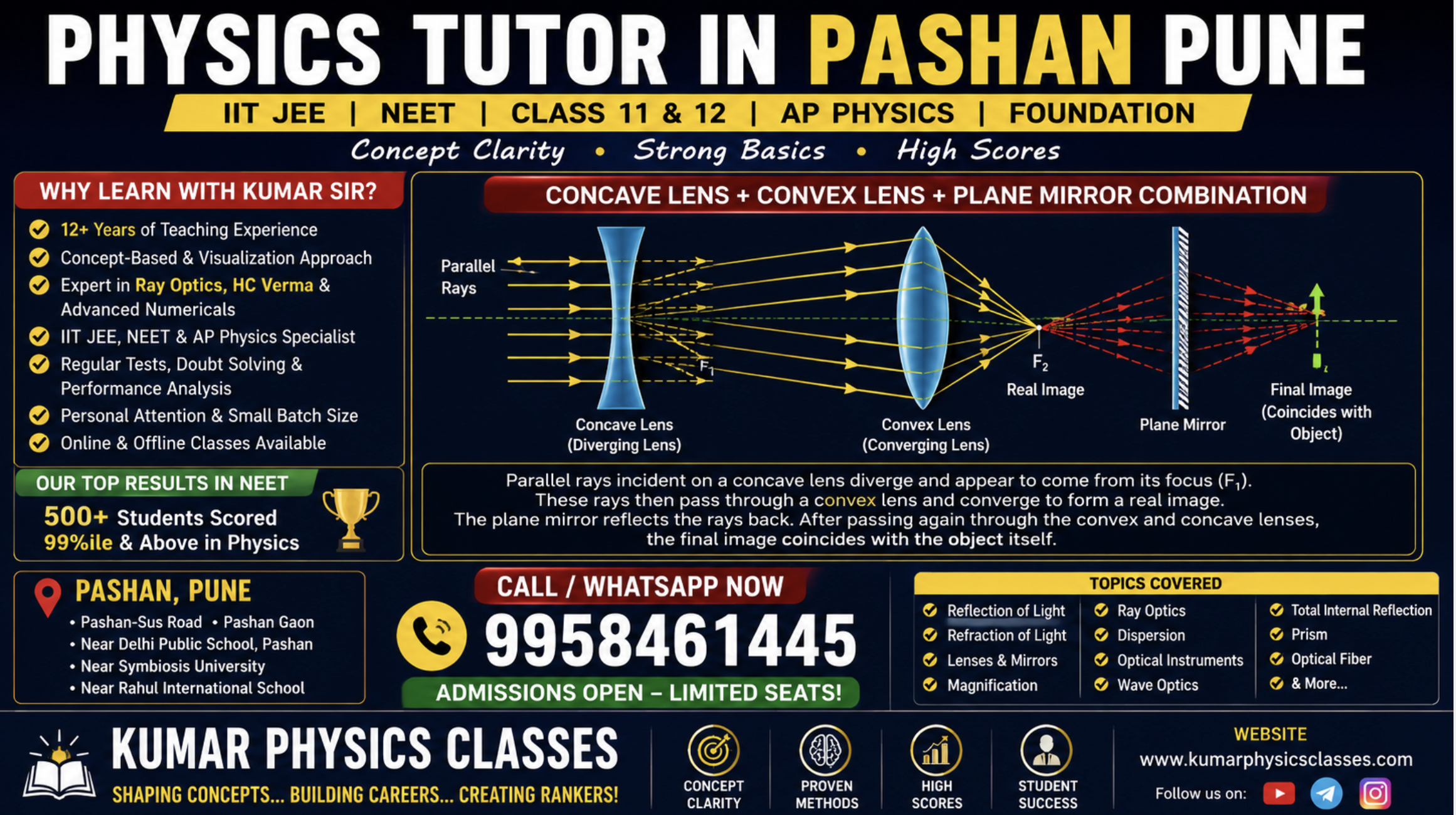
A real image of a point object is formed at a distance of 50 cm from a convex lens. A concave lens is placed 10 cm behind the convex lens on the image side. On placing a plane mirror beyond the concave lens, it is observed that the final image coincides with the object itself. Find the focal length of the concave lens.
Now according to Kumar Sir, the biggest mistake students make is that they directly jump into formulas. Instead, they should first understand the ray behaviour.
Step 1 – Understanding the Original Convex Lens Image
Initially, the convex lens forms a real image at 50 cm.
That means without the concave lens, light rays would naturally meet at a point 50 cm away from the convex lens.
Now a concave lens is inserted 10 cm behind the convex lens.
So relative to the concave lens, the rays would have met at:
[
50 – 10 = 40 \text{ cm}
]
This point acts as a virtual object for the concave lens.
According to sign convention:
[
u = +40 \text{ cm}
]
Why positive?
Because the object for the concave lens lies on the opposite side of incident rays.
This is where most students get confused.
Step 2 – Using the Mirror Condition
Now comes the most beautiful concept.
The final image coincides with the object itself.
Whenever a ray retraces its path after reflection from a plane mirror, it means the rays must have become parallel before reaching the mirror.
And when do rays become parallel?
They become parallel when the object is placed at the focus of a lens.
This is the key idea.
According to Kumar Sir:
Parallel rays through a convex lens meet at focus.
Rays directed toward focus emerge parallel.
In a concave lens, rays diverge as if coming from focus.
These are the concepts used here.
For the rays to retrace their path after reflection from the mirror, the concave lens must send parallel rays toward the mirror.
That means the virtual object must lie at the focal point of the concave lens.
Therefore:
[
f = -40 \text{ cm}
]
Negative sign comes because it is a concave lens.
Final Answer
f=-40\text{ cm}
How Kumar Sir Teaches Physics
Most students study Physics in a very mechanical way.
They memorize formulas like:
Lens formula
Mirror formula
Magnification
Refraction
Wave optics equations
But when a difficult reasoning question comes in JEE Advanced or NEET, they panic.
Kumar Sir focuses on developing real understanding.
Instead of memorization, students learn:
Why formulas work
How light actually behaves
Ray visualization
Sign convention logic
Physical interpretation of equations
Shortcut derivations
Smart numerical solving
This is why students who were weak in Physics start enjoying the subject after learning from Kumar Sir.
IIT JEE Physics by Kumar Sir
IIT JEE Physics is not about theory alone.
Students must develop:
Problem solving speed
Multi-concept thinking
Strong visualization
Deep fundamentals
Error analysis
Kumar Sir trains students on:
HC Verma
Coaching modules
Previous year IIT JEE questions
Advanced level numericals
Multi-correct questions
Integer type problems
Assertion reasoning
Graph interpretation
Students learn how to think like IIT JEE toppers.
NEET Physics Preparation
Many students fear NEET Physics because they feel Physics is difficult compared to Biology.
But according to Kumar Sir, NEET Physics becomes easy when concepts are crystal clear.
Kumar Sir explains:
Theory deeply
NCERT line by line
Numerical tricks
Fast solving methods
Concept applications
PYQ analysis
Mistake patterns
Many students have scored above 99 percentile in Physics after learning systematically with Kumar Sir.
The focus is always on:
Accuracy
Speed
Concept retention
Smart revision
Repeated application
AP Physics and International Curriculum
Students preparing for AP Physics also require conceptual clarity.
Kumar Sir teaches:
Algebra based Physics
Calculus based Physics
Mechanics
Electricity
Magnetism
Optics
Waves
Modern Physics
Special attention is given to derivations and conceptual understanding.
HC Verma Mastery
Many students buy HC Verma but cannot solve questions independently.
Kumar Sir explains:
Concept behind every question
Hidden assumptions
Multiple solving approaches
Graphical interpretation
Shortcut reasoning
Students learn how to attack Physics problems confidently.
Why Students Prefer Kumar Physics Classes
Students prefer Kumar Physics Classes because teaching is highly practical and result oriented.
Features include:
One-to-one attention
Live interactive classes
Numerical problem solving
Strong conceptual teaching
JEE and NEET focus
Doubt solving
Assignment discussion
Test analysis
Regular revision
Physics is taught in a structured and intelligent way.
What Students Should Look for in a Physics Teacher
According to Kumar Sir, students should never judge Physics teaching only by popularity.
A good Physics teacher should help students achieve:
More understanding in less time
Better accuracy
Faster solving
Deeper concepts
Confidence in numericals
Real Physics teaching means reducing confusion.
Physics Tutor in Nearby Areas of Pashan Pune
Physics Tutor in Pashan Pune
Physics Tutor in Baner Pune
Physics Tutor in Aundh Pune
Physics Tutor in Bavdhan Pune
Physics Tutor in Kothrud Pune
Physics Tutor in Hinjewadi Pune
Physics Tutor in Wakad Pune
Physics Tutor in Shivajinagar Pune
Physics Tutor in Karve Nagar Pune
Physics Tutor in Deccan Pune
Physics Tutor in Nearby Schools and Colleges
Physics Tutor in Mercedes Benz International School Pune
Physics Tutor in Loyola High School Pune
Physics Tutor in MIT Pune
Physics Tutor in Fergusson College Pune
Physics Tutor in BMCC Pune
Physics Tutor in Symbiosis College Pune
Physics Tutor in JSPM College Pune
Physics Tutor in Abasaheb Garware College Pune
Physics Tutor in Cummins College Pune
Physics Tutor in Modern College Pune
Specialized Physics Coaching Keywords
IIT JEE Physics Tutor in Pashan Pune
NEET Physics Tutor in Pashan Pune
AP Physics Tutor in Pashan Pune
Class 11 Physics Tutor in Pashan Pune
Class 12 Physics Tutor in Pashan Pune
Online Physics Tutor in Pashan Pune
HC Verma Physics Tutor in Pashan Pune
JEE Advanced Physics Tutor in Pashan Pune
NEET Physics Numericals Tutor in Pashan Pune
Ray Optics Tutor in Pashan Pune
Conclusion
Physics becomes beautiful when concepts are understood visually and logically.
According to Kumar Sir, every difficult numerical can become easy if students understand:
Ray behaviour
Physical meaning
Sign convention
Basic concepts
That is why students preparing for IIT JEE, NEET, AP Physics, and boards trust Kumar Physics Classes for deep conceptual learning and advanced numerical solving.
Ray Optics Topics for NEET – Complete Explanation by Kumar Sir
Ray Optics is one of the most important and scoring chapters in NEET Physics. Many direct numerical and conceptual questions are asked from this chapter every year. According to Kumar Sir, students should never study Ray Optics by memorizing formulas only. They should understand how light behaves, why reflection happens, why refraction happens, and how images are formed.
Below are the major topics of Ray Optics that every NEET aspirant must study carefully.
1. Reflection of Light
Reflection is the phenomenon in which light bounces back into the same medium after striking a surface.
The two laws of reflection are:
Angle of incidence equals angle of reflection
Incident ray, reflected ray, and normal lie in the same plane
There are two types of reflection:
Regular reflection
Diffuse reflection
Students must also study image formation in plane mirrors and spherical mirrors.
2. Plane Mirror
A plane mirror forms:
Virtual image
Erect image
Same size image
Laterally inverted image
Important concepts include:
Mirror symmetry
Multiple reflection
Rotation of mirror
Image shift
3. Spherical Mirrors
There are two types:
Concave mirror
Convex mirror
Students must study:
Pole
Radius of curvature
Principal axis
Focus
Focal length
Ray diagrams are extremely important in NEET.
4. Mirror Formula
For spherical mirrors:
genui{“math_block_widget_always_prefetch_v2”:{“content”:”\frac{1}{f}=\frac{1}{v}+\frac{1}{u}”}}
Students must learn proper sign convention carefully because many mistakes happen there.
5. Magnification
Magnification tells us image size relative to object size.
m=-\frac{v}{u}=\frac{h_2}{h_1}
Positive magnification means erect image while negative magnification means inverted image.
6. Refraction of Light
Refraction is bending of light when it moves from one medium to another due to change in speed.
The laws of refraction are given by Snell’s law.
n_1\sin i=n_2\sin r
Students should understand:
Rarer to denser medium
Denser to rarer medium
Apparent depth
Refraction through glass slab
7. Refractive Index
Refractive index measures how much light slows inside a medium.
n=\frac{c}{v}
Topics include:
Absolute refractive index
Relative refractive index
Optical density
Speed of light in medium
8. Total Internal Reflection
This is one of the most important NEET topics.
When light travels from denser to rarer medium and angle of incidence exceeds critical angle, reflection occurs completely inside the medium.
Applications include:
Optical fiber
Mirage
Diamond brilliance
9. Prism
Students must study:
Refraction through prism
Angle of deviation
Minimum deviation
Prism formula
White light splits into seven colours because different colours have different refractive indices.
This phenomenon is called dispersion of light.
10. Dispersion of Light
Dispersion occurs because different colours bend differently in a prism.
Violet deviates most
Red deviates least
Important concepts:
VIBGYOR
Angular dispersion
Rainbow formation
11. Refraction Through Spherical Surfaces
Students should study image formation through curved surfaces and relation between object distance, image distance, and refractive index.
12. Lenses
There are two types:
Convex lens
Concave lens
Students must study:
Lens terminology
Focal length
Power of lens
Sign convention
Ray diagrams
13. Lens Formula
\frac{1}{f}=\frac{1}{v}-\frac{1}{u}
This formula is extremely important for NEET numericals.
14. Power of Lens
P=\frac{1}{f}
Power is measured in dioptre.
Students must also study combination of lenses.
15. Optical Instruments
This section is very important in NEET.
Students study:
Simple microscope
Compound microscope
Astronomical telescope
Important concepts include:
Magnifying power
Angular magnification
Least distance of distinct vision
How Kumar Sir Teaches Ray Optics
According to Kumar Sir, Ray Optics becomes easy only when students visualize rays properly.
Students are taught:
Concept clarity
Ray diagrams
Sign convention tricks
Fast numerical solving
NEET PYQs
HC Verma problems
Assertion reasoning
Diagram-based questions
Every concept is explained from basics to advanced level.
That is why students preparing for:
NEET
IIT JEE
Class 11 Physics
Class 12 Physics
AP Physics
find Ray Optics much easier after learning from Kumar Sir.