
Physics Tutor in Boat Club Road Pune – Electric Potential, Work Done and Potential Energy Explained by Kumar
+91-9958461445
Electrostatics is one of the most important and conceptual chapters in Physics. Students preparing for NEET Physics, IIT-JEE Physics, AP Physics, IB Physics, A Level Physics, IGCSE Physics, CBSE Physics, ICSE Physics, and engineering entrance examinations often feel confused in topics such as electric field, electric potential, potential energy, work done, and electrostatic force because these concepts involve both Mathematics and physical understanding.
At Kumar Physics Classes Boat Club Road Pune, students are taught these concepts step-by-step with real conceptual understanding instead of rote memorization. Kumar Sir mainly follows conceptual books such as H.C. Verma, Resnick Halliday, and I.E. Irodov so that students develop strong Physics foundations and analytical thinking ability.
If you are living in Boat Club Road Pune or nearby localities and searching for a Physics Tutor for NEET Physics, IIT-JEE Physics, AP Physics, IB Physics, A Level Physics, IGCSE Physics, CBSE Physics, ICSE Physics, or college-level Physics, then Kumar Physics Classes can help you understand even difficult concepts in a very simple and logical manner.
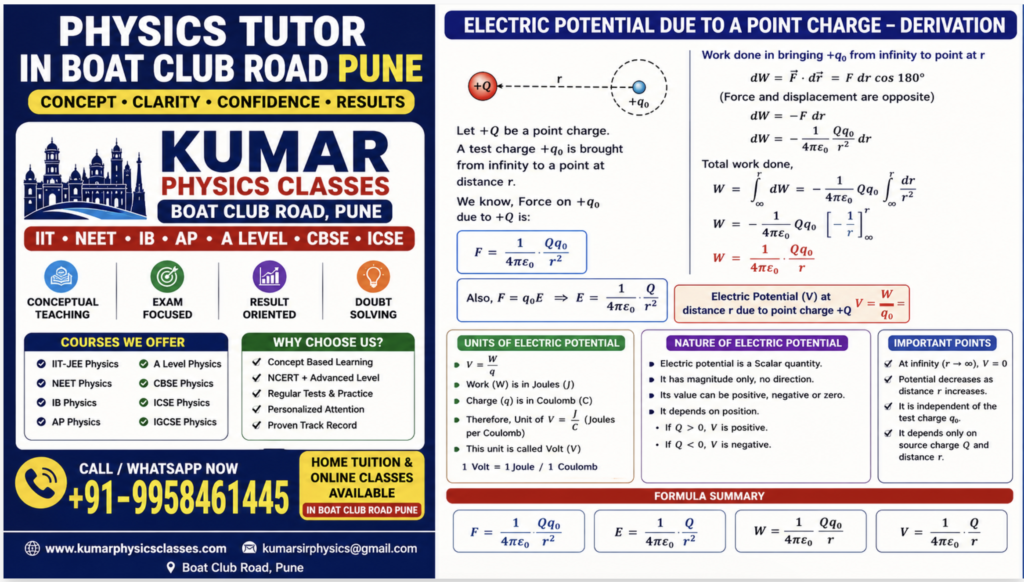
What is Electric Potential?
Electric potential is defined as:
Work done per unit positive charge in bringing a test charge from infinity to a particular point against electrostatic force.
This is one of the most important definitions in Electrostatics.
Students must understand that electric potential is related to:
work done
electric field
force
displacement
Electric potential tells how much work is required to bring charge from infinity to a point.
Understanding Test Charge
Suppose we place a charge:
Q
in space.
Now another small positive test charge:
Q0
is brought near it.
Then electrostatic force acts on the test charge.
According to Coulomb’s Law:
F = QQ0 / R²
We also know:
F = Q0E
Where:
E = electric field
Q0 = test charge
This means electric field represents force per unit charge.
Work Done in Electrostatics
Students must clearly understand work done.
Small work done is written as:
dW = F · dr
Here:
F = force
dr = small displacement
Now carefully understand one important thing.
When a positive test charge is brought toward another positive charge, electrostatic force acts outward.
But displacement is inward.
Therefore force and displacement are opposite.
Hence angle between them becomes:
180 degrees
This is extremely important.
Why Cos(180 Degrees) Comes
We know:
cos(180 degrees) = -1
Therefore:
dW = F dr cos(180 degrees)
Hence negative sign appears in the derivation.
Students often memorize formulas without understanding why negative sign appears.
At Kumar Physics Classes Boat Club Road Pune, every step is explained physically and mathematically.
Expression for Electric Field
Electric field due to point charge is:
E = (1 / 4pi epsilon0) × (Q / R²)
Substitute this value into work done equation.
Then integrate from:
infinity to R
This integration gives the expression for electric potential.
Formula for Electric Potential
After integration, electric potential becomes:
V = (1 / 4pi epsilon0) × (Q / R)
This is one of the most important formulas in Electrostatics.
Students preparing for NEET and IIT-JEE must remember this carefully.
Physical Meaning of Electric Potential
Electric potential represents:
work required per unit charge.
Higher potential means more work is needed to bring charge.
Potential depends upon:
magnitude of charge
distance from charge
Why Infinity is Taken as Reference
Students often ask:
Why infinity is taken?
At infinity, electrostatic force becomes almost zero.
Therefore potential at infinity is assumed zero.
This simplifies calculations greatly.
What is Potential Energy?
Potential energy is the energy possessed by a body because of its position or configuration.
In Electrostatics:
Potential energy develops because of interaction between charges.
Potential energy is a scalar quantity.
This is extremely important.
Students often confuse scalar and vector quantities.
Potential energy has:
magnitude only
no direction
Relation Between Potential and Potential Energy
Potential:
work done per unit charge.
Potential energy:
total work done.
Relation:
U = qV
Where:
U = potential energy
q = charge
V = electric potential
Why Electrostatics is Important
Electrostatics is one of the highest-weightage chapters in:
NEET Physics
IIT-JEE Main
IIT-JEE Advanced
AP Physics
IB Physics
A Level Physics
Olympiads
Questions are frequently asked from:
electric field
electric potential
potential energy
capacitors
Gauss law
Coulomb law
Why Students Fear Electrostatics
Students generally fear Electrostatics because of:
vectors
integration
calculus
electric field lines
mathematical derivations
But when concepts are visualized physically, the chapter becomes very easy.
At Kumar Physics Classes Boat Club Road Pune, students learn through:
conceptual explanation
graphical interpretation
mathematical derivation
numerical practice
real-life applications
Importance of H.C. Verma and Irodov
Kumar Sir mainly follows:
H.C. Verma
Resnick Halliday
I.E. Irodov
because these books develop:
conceptual clarity
analytical ability
problem-solving techniques
deep Physics understanding
Students preparing for IIT-JEE Advanced and Olympiads especially benefit from this approach.
Real-Life Applications of Electric Potential
Electric potential concepts are used in:
capacitors
batteries
electrical circuits
communication systems
electronic devices
electrostatic precipitators
photocopy machines
laser printers
This shows how important Electrostatics is in modern technology.
Common Mistakes Students Make
Mistake 1 – Confusing Electric Field and Potential
Electric field is vector quantity.
Potential is scalar quantity.
Mistake 2 – Forgetting Negative Sign
Negative sign appears because displacement and force are opposite.
Mistake 3 – Memorizing Without Understanding
Students should understand derivation physically.
Why Students Choose Kumar Physics Classes
Students choose Kumar Physics Classes because:
difficult concepts become simple
theory is explained deeply
derivations are taught step-by-step
NEET and IIT-JEE preparation is provided
international curriculum support is available
advanced numericals are practiced
Students from top schools and coaching institutes take conceptual guidance from Kumar Sir.
Physics Tutor in Boat Club Road Pune – Areas Covered
Physics Tutor in Boat Club Road Pune, Physics Tutor in Koregaon Park Pune, Physics Tutor in Camp Pune, Physics Tutor in Kalyani Nagar Pune, Physics Tutor in Viman Nagar Pune, Physics Tutor in Magarpatta Pune, Physics Tutor in Kharadi Pune, Physics Tutor in Hadapsar Pune, Physics Tutor in Yerawada Pune, Physics Tutor in Lohegaon Pune
Physics Tutor Near Schools and Universities
Physics Tutor in Bishop’s School Pune, Physics Tutor in Symbiosis International School Pune, Physics Tutor in Vibgyor High School Pune, Physics Tutor in Lexicon International School Pune, Physics Tutor in Delhi Public School Pune, Physics Tutor in MIT World Peace University Pune, Physics Tutor in COEP Pune, Physics Tutor in Symbiosis Pune
Physics Tutor for Different Curriculums
Physics Tutor in NEET Physics Pune, Physics Tutor in IIT-JEE Physics Pune, Physics Tutor in AP Physics Pune, Physics Tutor in IB Physics Pune, Physics Tutor in A Level Physics Pune, Physics Tutor in IGCSE Physics Pune, Physics Tutor in British Curriculum Physics Pune, Physics Tutor in CBSE Physics Pune, Physics Tutor in ICSE Physics Pune
Contact Kumar Physics Classes
Website: kumarphysicsclasses.com
Contact Number: +91-9958461445
Email: KUMARSIRPHYSICS@GMAIL.COM
Coaching Available For:
NEET Physics
IIT-JEE Physics
AP Physics
IB Physics
A Level Physics
IGCSE Physics
CBSE Physics
ICSE Physics
College Physics
Conclusion
Electric potential and potential energy are among the most fundamental concepts in Electrostatics.
Students who understand:
electric field
electrostatic force
work done
electric potential
potential energy
integration in electrostatics
scalar quantities
develop a very strong Physics foundation.
At Kumar Physics Classes Boat Club Road Pune, Electrostatics is taught conceptually, visually, logically, and mathematically so that students can confidently solve NEET Physics, IIT-JEE Physics, AP Physics, IB Physics, A Level Physics, IGCSE Physics, and Olympiad-level questions.
Capacitors have many important industrial applications in electrical and electronic systems. One of the most important uses of capacitors is power factor improvement in industries. Large factories use motors and inductive machines which decrease power factor. Capacitor banks are connected in parallel to improve power factor, reduce energy loss, and decrease electricity bills.
Capacitors are also used in filters and signal processing circuits. In electronic industries, they help remove unwanted noise and provide smooth DC output in rectifier circuits.
Another important application is in starting electric motors. Ceiling fans, pumps, compressors, and industrial motors use capacitors to create phase difference and provide starting torque.
Capacitors are widely used in communication systems such as radio transmitters, television circuits, mobile communication devices, and tuning circuits. In RLC resonance circuits, capacitors help select desired frequencies.
They are also used in energy storage devices. Camera flashes and pulse circuits store electrical energy temporarily inside capacitors and release it quickly when needed.
In industries, capacitors are additionally used in:
UPS systems
voltage stabilizers
computer motherboards
welding machines
medical equipment
automation systems
Thus, capacitors play a very important role in modern electrical, electronic, and industrial technology.
Electric Flux:
Electric flux is the total electric field passing normally through a surface.
Gauss Theorem:
Total electric flux through a closed surface equals charge enclosed divided by epsilon zero.
Electric Potential Energy:
Electric potential energy is the energy possessed by a charge due to its position.
Electric Potential:
Electric potential is work done per unit positive charge from infinity to a point.
Capacitance:
Capacitance is the ability of a conductor or capacitor to store electric charge.