
Physics Tutor In Hyderabad – Simple Pendulum, SHM and Time Loss Problem Explained by Kumar Sir
+91-9958461445
If you are searching for a Physics Tutor In Hyderabad, then Kumar Sir’s one-to-one online Physics classes can help you understand difficult topics like Simple Pendulum, SHM, Oscillations, NEET Physics, JEE Physics, CBSE Physics, IB Physics, AP Physics and A-Level Physics in a very simple and concept-based manner.
Kumar Sir always teaches Physics by first building the concept, then deriving the formula, and then applying it in numerical problems. In this article, we will understand the derivation of the time period of a simple pendulum, the condition of Simple Harmonic Motion, and one important numerical:
If the length of a seconds pendulum is decreased by 2%, how many seconds will it lose or gain per day?
Simple Pendulum Definition
A simple pendulum consists of a small heavy bob suspended from a fixed point by a light, inextensible string. When the bob is displaced slightly from its mean position and released, it performs oscillatory motion.
For small angular displacement, the motion of a simple pendulum is approximately Simple Harmonic Motion.
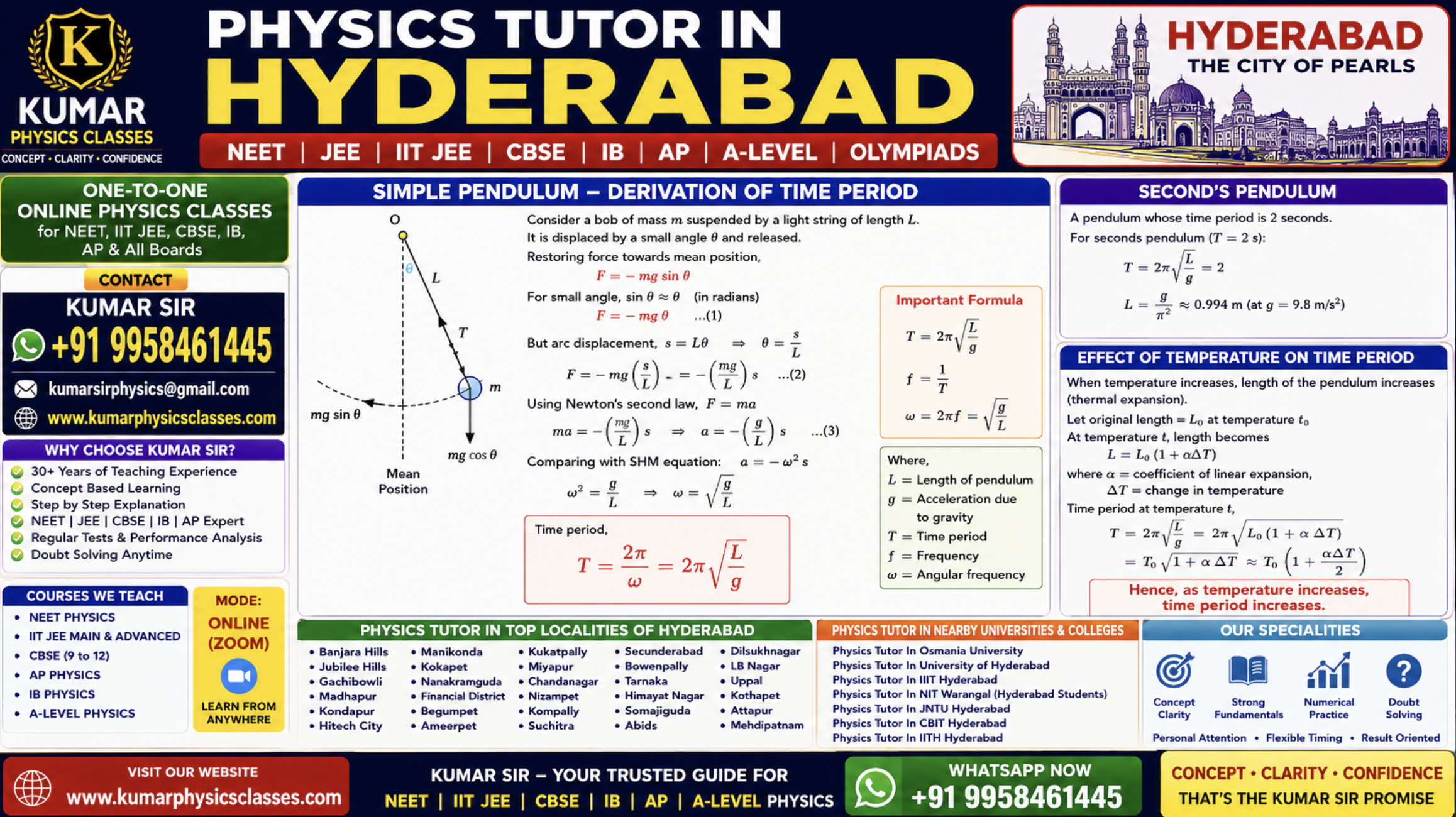
Simple Pendulum Diagram
              Fixed Support
                  O
                  |
                  | L
                  |
                  |
                  ● Bob
                 /|
                / |
               /θ |
              /   |
        Mean Position
Here:
L = length of pendulum
m = mass of bob
θ = small angular displacement
g = acceleration due to gravity
T = time period
Condition for Simple Harmonic Motion
A motion is called Simple Harmonic Motion if restoring force or restoring acceleration is directly proportional to displacement and always directed towards the mean position.
F ∝ -x
or
a ∝ -x
Mathematically:
a = -ω²x
where:
ω = angular frequency
x = displacement
The negative sign shows that acceleration is always directed towards the mean position.
Derivation of Time Period of Simple Pendulum
For a pendulum displaced by a small angle θ:
Restoring force = -mg sinθ
For small angle:
sinθ ≈ θ
So,
Restoring force = -mgθ
Now,
Arc displacement, s = Lθ
Therefore,
θ = s/L
So,
F = -mg(s/L)
Using Newton’s second law:
F = ma
Therefore,
ma = -mg(s/L)
Cancel m:
a = -(g/L)s
Compare with SHM equation:
a = -ω²s
So,
ω² = g/L
Therefore,
ω = √(g/L)
Time period:
T = 2π/ω
So,
T = 2π√(L/g)
This is the time period of a simple pendulum.
Important Formula
T = 2π√(L/g)
From this formula:
T ∝ √L
So in error form:
ΔT/T = 1/2 × ΔL/L
Numerical: Length of Seconds Pendulum Decreased by 2%
Given:
ΔL/L = 2% = 0.02
Using:
ΔT/T = 1/2 × ΔL/L
ΔT/T = 1/2 × 0.02
ΔT/T = 0.01
So percentage change in time period:
ΔT/T = 1%
Now, one day has:
24 × 60 × 60 = 86400 seconds
Time change per day:
= 0.01 × 86400
= 864 seconds
Since length is decreased, time period decreases. Therefore, pendulum becomes faster and gains time.
Final answer:
The pendulum will gain 864 seconds per day.
or
The pendulum will gain 14 minutes 24 seconds per day.
Kumar Sir Style Explanation
देखो बेटा, formula याद रखने से Physics नहीं आती। पहले relation समझो:
T = 2π√(L/g)
इसका मतलब है कि time period length के square root पर depend करता है.
अगर length कम होगी, तो time period भी कम होगा. जब time period कम हो गया, तो pendulum जल्दी-जल्दी oscillate करेगा. इसलिए clock fast चलेगी और time gain करेगी.
25 Conceptual Questions with Answers on SHM, Oscillation and Periodic Motion
1. What is periodic motion?
Answer: Motion which repeats itself after equal intervals of time is called periodic motion. Example: motion of Earth around the Sun.
2. What is oscillatory motion?
Answer: To and fro motion of a body about its mean position is called oscillatory motion. Example: simple pendulum.
3. Is every oscillatory motion periodic?
Answer: Ideally yes, if there is no damping. In real life, damping reduces amplitude, so motion may not remain perfectly periodic.
4. Is every periodic motion SHM?
Answer: No. Every SHM is periodic, but every periodic motion is not SHM.
5. What is the basic condition for SHM?
Answer: Restoring force must be directly proportional to displacement and opposite in direction.
F ∝ -x
F = -kx
6. What is the acceleration condition for SHM?
Answer: Acceleration must be directly proportional to displacement and directed towards mean position.
a = -ω²x
7. Why is negative sign used in SHM equation?
Answer: Negative sign shows that restoring force or acceleration is always directed opposite to displacement.
8. What is amplitude?
Answer: Maximum displacement from mean position is called amplitude.
9. What is time period?
Answer: Time taken to complete one oscillation is called time period.
T = 1/f
10. What is frequency?
Answer: Number of oscillations completed per second is called frequency.
f = 1/T
11. What is angular frequency?
Answer: Angular frequency is rate of change of phase.
ω = 2πf = 2π/T
12. What is displacement equation of SHM?
Answer:
x = A sin(ωt + φ)
or
x = A cos(ωt + φ)
13. What is velocity in SHM?
Answer:
v = ω√(A² - x²)
Maximum velocity:
vmax = ωA
14. Where is velocity maximum in SHM?
Answer: At mean position, because displacement is zero and kinetic energy is maximum.
15. Where is velocity zero in SHM?
Answer: At extreme positions.
16. What is acceleration in SHM?
Answer:
a = -ω²x
17. Where is acceleration maximum in SHM?
Answer: At extreme positions, because displacement is maximum.
18. Where is acceleration zero in SHM?
Answer: At mean position.
19. What is total energy in SHM?
Answer:
E = 1/2 kA²
Total energy remains constant if there is no damping.
20. Where is kinetic energy maximum in SHM?
Answer: At mean position.
21. Where is potential energy maximum in SHM?
Answer: At extreme positions.
22. What is the time period of spring-mass system?
Answer:
T = 2π√(m/k)
23. What is the time period of simple pendulum?
Answer:
T = 2π√(L/g)
24. Does time period of simple pendulum depend on mass?
Answer: No, time period of simple pendulum does not depend on mass of bob.
25. If length of pendulum increases, what happens to time period?
Answer: Time period increases because:
T ∝ √L
So, longer pendulum oscillates slowly.
Physics Tutor In Hyderabad for NEET, JEE, CBSE, IB and AP Physics
Students from Hyderabad often face difficulty in topics like SHM, Waves, Electrostatics, Current Electricity, Magnetism, Optics and Modern Physics. Kumar Sir teaches these topics step by step with derivations, numerical practice and exam-oriented shortcuts.
If you live in Hyderabad and want personal online Physics guidance, you can contact Kumar Sir for one-to-one Physics classes.
Importance of Simple Harmonic Motion and Oscillations in NEET and IIT JEE
Simple Harmonic Motion and Oscillations are very important chapters for NEET and IIT JEE because they build the foundation of many Physics topics. Kumar Sir always says that SHM is not just one chapter; it is a language of Physics. If a student understands SHM properly, then Waves, Sound, AC circuits, Modern Physics and even some parts of Mechanics become much easier.
In NEET, questions from SHM are usually formula-based but concept-sensitive. Students must clearly know amplitude, time period, frequency, angular frequency, velocity, acceleration and energy in SHM. A small confusion between mean position and extreme position can make the answer wrong. For example, velocity is maximum at mean position, while acceleration is maximum at extreme position.
In IIT JEE, SHM questions are more conceptual and mixed with other chapters. Spring-mass system, simple pendulum, energy method, combination of springs and SHM in vertical motion are frequently asked. JEE also tests whether the student can identify SHM from the condition:
a = -ω²x
or
F = -kx
Kumar Sir teaches this chapter by first explaining the physical meaning of restoring force. Once the student understands why the body comes back towards the mean position, formulas become very easy. Then numerical problems become logical instead of memorized.
Oscillations are also important because they connect real-life systems like pendulum clocks, vibrating strings, springs, sound waves and electrical oscillations. So, for NEET and IIT JEE students, SHM should be studied with proper diagrams, derivations and practice questions. A strong command over SHM gives confidence in both board exams and competitive exams.
Physics Tutor In Banjara Hills Hyderabad, Physics Tutor In Jubilee Hills Hyderabad, Physics Tutor In Gachibowli Hyderabad, Physics Tutor In Madhapur Hyderabad, Physics Tutor In Kondapur Hyderabad, Physics Tutor In Hitech City Hyderabad, Physics Tutor In Kukatpally Hyderabad, Physics Tutor In Begumpet Hyderabad, Physics Tutor In Ameerpet Hyderabad, Physics Tutor In Secunderabad Hyderabad, Physics Tutor In Manikonda Hyderabad, Physics Tutor In Nanakramguda Hyderabad, Physics Tutor In Financial District Hyderabad, Physics Tutor In Kokapet Hyderabad, Physics Tutor In Nallagandla Hyderabad, Physics Tutor In Miyapur Hyderabad, Physics Tutor In Chandanagar Hyderabad, Physics Tutor In Tolichowki Hyderabad, Physics Tutor In Mehdipatnam Hyderabad, Physics Tutor In Himayat Nagar Hyderabad, Physics Tutor In Somajiguda Hyderabad, Physics Tutor In Abids Hyderabad, Physics Tutor In Koti Hyderabad, Physics Tutor In Dilsukhnagar Hyderabad, Physics Tutor In Uppal Hyderabad, Physics Tutor In LB Nagar Hyderabad, Physics Tutor In Attapur Hyderabad, Physics Tutor In Shamshabad Hyderabad, Physics Tutor In Kompally Hyderabad, Physics Tutor In Sainikpuri Hyderabad, Physics Tutor In Tarnaka Hyderabad, Physics Tutor In Bowenpally Hyderabad, Physics Tutor In Nizampet Hyderabad, Physics Tutor In Pragathi Nagar Hyderabad, Physics Tutor In Bachupally Hyderabad, Physics Tutor In Tellapur Hyderabad, Physics Tutor In Raidurg Hyderabad, Physics Tutor In Osman Nagar Hyderabad, Physics Tutor In Khajaguda Hyderabad, Physics Tutor In Serilingampally Hyderabad
NEET Physics Tutor In Hyderabad, IIT Physics Tutor In Hyderabad, JEE Physics Tutor In Hyderabad, CBSE Physics Tutor In Hyderabad, IB Physics Tutor In Hyderabad, AP Physics Tutor In Hyderabad, A-Level Physics Tutor In Hyderabad, Physics Tutor For NEET Dropper Students In Hyderabad
Why Choose Kumar Sir?
Kumar Sir has more than 30 years of teaching experience. He teaches Physics in a very simple way, starting from basic concepts and then moving to derivations and numerical problems.
Students can learn online through Zoom from anywhere in Hyderabad. Whether you are preparing for NEET, JEE, CBSE, IB, AP Physics or A-Level Physics, Kumar Sir helps you build strong fundamentals.
For Physics classes, contact Kumar Sir:
Kumar Physics Classes
Phone / WhatsApp: +91-9958461445
Email: kumarsirphysics@gmail.com
Website: kumarphysicsclasses.com