Physics Tutor in Besa Nagpur – Quantisation of Charge, Induction and Charge Density
+91-9958461445
If you are living in Besa Nagpur and searching for a good Physics tutor for NEET, JEE, CBSE, IB, AP Physics or IIT Advanced Physics, then Kumar Sir can help you understand Physics in a very simple and logical way. Kumar Sir teaches Physics with concept clarity, step-by-step explanation and numerical practice.
Students from Besa Nagpur often face difficulty in topics like electrostatics, charge, electric field, induction, charge density and capacitors. These topics look simple, but many students make mistakes because their basic concepts are not clear.
Just like Nagpur is famous for oranges, Kumar Sir’s Physics is famous for clear concepts.
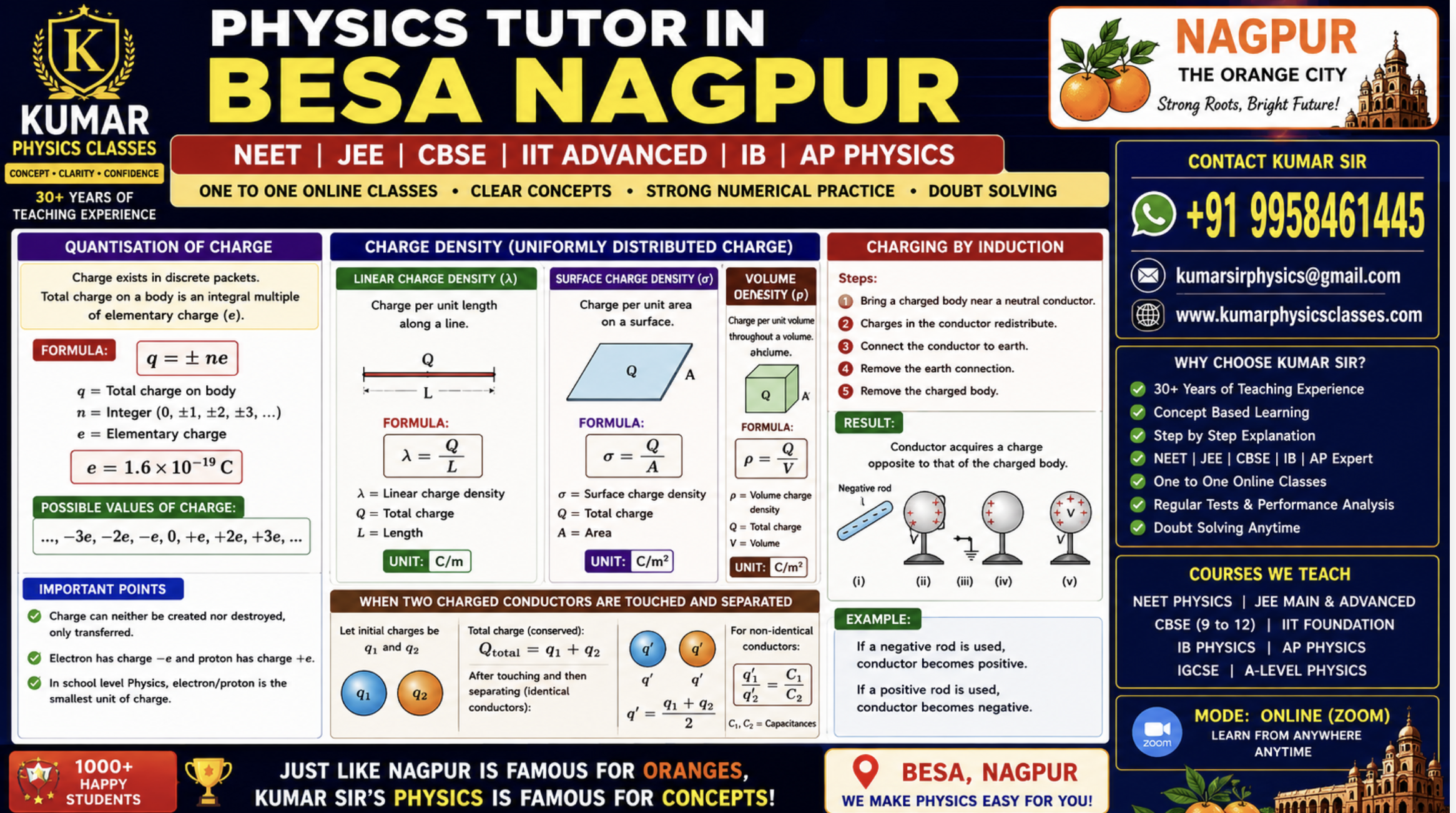
What is Quantisation of Charge?
Quantisation of charge means that charge exists in discrete packets. Charge cannot have any random value. The total charge on a body is always an integral multiple of the basic charge.
Copy-paste formula:
q = ne
Where:
q = total charge
n = integer number
e = charge of one electron
The value of elementary charge is:
e = 1.6 × 10^-19 C
So possible charges are:
±e, ±2e, ±3e, ±4e, ...
But charges like:
1.5e, 2.3e, 4.7e
are not possible for an isolated body.
Is Electron the Smallest Charged Particle?
In school-level and NEET/JEE Physics, electron is considered the basic unit of negative charge. The charge of an electron is:
Charge on electron = -1.6 × 10^-19 C
The charge on proton is:
Charge on proton = +1.6 × 10^-19 C
At higher level Physics, quarks have fractional charges, but quarks are not found freely in normal conditions. Therefore, for school, NEET and JEE level, the smallest freely existing charge is the charge of an electron or proton.
Charging by Friction
When two bodies are rubbed together, electrons transfer from one body to another. The body which loses electrons becomes positively charged, and the body which gains electrons becomes negatively charged.
Example:
When a glass rod is rubbed with silk, electrons transfer from glass to silk. So glass becomes positively charged and silk becomes negatively charged.
Important point:
Charge is not created.
Charge is only transferred.
This is called conservation of charge.
Charging by Induction
Charging by induction means charging a body without direct contact.
Suppose a negatively charged rod is brought near a neutral conductor. The free electrons inside the conductor move away from the rod. The near side becomes positively charged and the far side becomes negatively charged.
If the conductor is connected to earth, electrons flow to the ground. After removing the earth connection and then removing the charged rod, the conductor becomes positively charged.
This process is called charging by induction.
Conservation of Charge
When two charged bodies are touched and then separated, total charge remains conserved.
If two bodies have charges q1 and q2, then total charge is:
Total charge = q1 + q2
After touching, charge redistributes, but total charge remains same.
For identical conductors:
Final charge on each conductor = (q1 + q2) / 2
This is very important for NEET and JEE numerical questions.
Types of Charge Density
When charge is uniformly distributed, we use charge density to describe the distribution.
1. Linear Charge Density
If charge is distributed along a line, then charge per unit length is called linear charge density.
λ = Q / L
Where:
λ = linear charge density
Q = total charge
L = length
Unit:
C/m
2. Surface Charge Density
If charge is distributed on a surface, then charge per unit area is called surface charge density.
σ = Q / A
Where:
σ = surface charge density
Q = total charge
A = area
Unit:
C/m^2
3. Volume Charge Density
If charge is distributed throughout a volume, then charge per unit volume is called volume charge density.
ρ = Q / V
Where:
ρ = volume charge density
Q = total charge
V = volume
Unit:
C/m^3
Kumar Sir Style Concept
Kumar Sir explains charge in a very simple way: charge is like money in packets. You cannot have random packets. Similarly, charge exists in multiples of e. If a body has extra electrons, it becomes negative. If it loses electrons, it becomes positive. In friction, charge transfers by rubbing. In induction, charge redistributes without touching.
Physics Tutor in Besa Nagpur and Nearby Areas
Physics Tutor in Besa Nagpur, Physics Tutor in Manish Nagar Nagpur, Physics Tutor in Beltarodi Nagpur, Physics Tutor in Somalwada Nagpur, Physics Tutor in Narendra Nagar Nagpur, Physics Tutor in Wardha Road Nagpur, Physics Tutor in MIHAN Nagpur, Physics Tutor in Khapri Nagpur, Physics Tutor in Ajni Nagpur, Physics Tutor in Laxmi Nagar Nagpur, Physics Tutor in Pratap Nagar Nagpur, Physics Tutor in Civil Lines Nagpur, Physics Tutor in Dharampeth Nagpur, Physics Tutor in Ramdaspeth Nagpur, Physics Tutor in Shankar Nagar Nagpur, Physics Tutor in Bajaj Nagar Nagpur, Physics Tutor in Hingna Road Nagpur, Physics Tutor in Butibori Nagpur, Physics Tutor in Airport Area Nagpur, Physics Tutor in Trimurti Nagar Nagpur
Physics Tutor for Courses
NEET Physics Tutor, IIT Physics Tutor, JEE Physics Tutor, CBSE Physics Tutor, IB Physics Tutor, AP Physics Tutor, IGCSE Physics Tutor, A-Level Physics Tutor
Contact Kumar Sir
Kumar Physics Classes
Physics Tutor for NEET, JEE, CBSE, IB and AP Physics
30+ Years Teaching Experience
Contact: +91-9958461445
Email: kumarsirphysics@gmail.com
Website: kumarphysicsclasses.com
Mode: One-to-one online Physics classes
If you are searching for Physics Tutor in Besa Nagpur, Kumar Sir can help you build strong Physics concepts from basic to advanced level.
नीचे 20 CBSE-style questions with answers हैं, topic: Charging by Induction / Induction of Charge.
20 Questions on Charging by Induction with Answers
1. What is charging by induction?
Answer: Charging by induction is the process of charging a body without direct contact with a charged body.
2. Is contact necessary in charging by induction?
Answer: No, contact is not necessary. Charge is produced due to redistribution of charges.
3. What happens when a charged rod is brought near a neutral conductor?
Answer: Charges inside the conductor redistribute. Opposite charge appears near the rod and similar charge moves to the far side.
4. Why does charge redistribution occur in a conductor?
Answer: Because free electrons in a conductor can move easily under the influence of electric field.
5. Can an insulator be charged by induction?
Answer: Yes, but only polarization occurs mainly. Free movement of charge is not possible as in conductors.
6. What is polarization?
Answer: Polarization is the slight separation of positive and negative charges inside a neutral body due to an external charged body.
7. If a negatively charged rod is brought near a neutral conductor, what happens?
Answer: Electrons in the conductor move away from the rod. The near side becomes positive and the far side becomes negative.
8. If a positively charged rod is brought near a neutral conductor, what happens?
Answer: Electrons in the conductor move towards the rod. The near side becomes negative and the far side becomes positive.
9. What is the role of earthing in induction?
Answer: Earthing allows excess electrons to flow to or from the earth, helping the conductor get a permanent charge.
10. Why is earth considered a large reservoir of charge?
Answer: Because earth can accept or supply a very large amount of charge without any noticeable change in its potential.
11. In induction, is total charge conserved?
Answer: Yes, total charge is always conserved.
12. Can a neutral object attract a charged object?
Answer: Yes, due to induction or polarization, a neutral object can be attracted by a charged object.
13. Why are small paper pieces attracted by a charged comb?
Answer: The charged comb induces opposite charge on the near side of paper pieces, causing attraction.
14. What charge is induced near a positive rod?
Answer: Negative charge is induced near a positive rod.
15. What charge is induced near a negative rod?
Answer: Positive charge is induced near a negative rod.
16. What is the final charge on a conductor if a negative rod is used for induction with earthing?
Answer: The conductor becomes positively charged.
17. What is the final charge on a conductor if a positive rod is used for induction with earthing?
Answer: The conductor becomes negatively charged.
18. Why should the earth connection be removed before removing the charged rod?
Answer: If the charged rod is removed first, charges may redistribute again and the conductor may become neutral.
19. What is the difference between charging by conduction and induction?
Answer: In conduction, direct contact is required. In induction, direct contact is not required.
20. Why is induction important in electrostatics?
Answer: It explains attraction between charged and neutral bodies, working of electroscope, lightning protection and charge redistribution.