
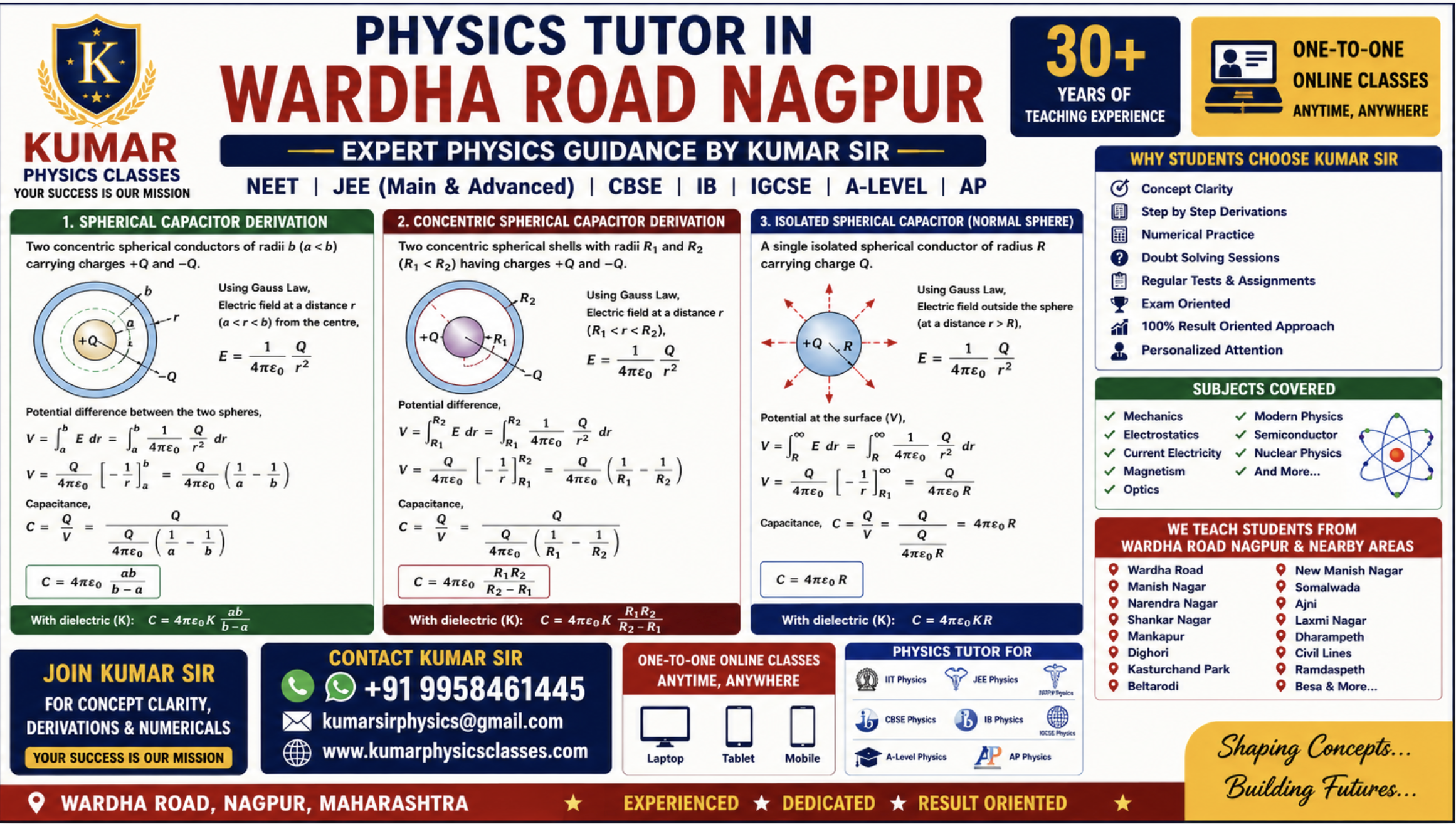
Physics Tutor in Wardha Road Nagpur – Spherical Capacitor and Cylindrical Capacitor Derivation
+91-9958461445
If you are searching for Physics Tutor in Wardha Road Nagpur, then Kumar Sir’s one-to-one Physics classes can help you understand difficult Class 12, NEET and JEE topics like spherical capacitor, cylindrical capacitor, concentric spherical capacitor, electric field, potential difference and capacitance with full concept clarity.
Students from Physics Tutor in Wardha Road Nagpur, Physics Tutor in Manish Nagar Nagpur, Physics Tutor in Narendra Nagar Nagpur, Physics Tutor in Somalwada Nagpur, Physics Tutor in Chhatrapati Square Nagpur, Physics Tutor in Ajni Nagpur, Physics Tutor in Pratap Nagar Nagpur, Physics Tutor in Laxmi Nagar Nagpur, Physics Tutor in Ramdaspeth Nagpur, Physics Tutor in Dharampeth Nagpur can join Kumar Sir online.
Students from Physics Tutor in Centre Point School Wardhaman Nagar Nagpur, Physics Tutor in School of Scholars Nagpur, Physics Tutor in Narayana Vidyalayam Nagpur, Physics Tutor in Delhi Public School Nagpur, Physics Tutor in Bhavan’s Bhagwandas Purohit Vidya Mandir Nagpur, Physics Tutor in Rashtrasant Tukadoji Maharaj Nagpur University, Physics Tutor in VNIT Nagpur can also learn Physics personally from Kumar Sir.
For exams, students can join Physics Tutor for IIT Physics, Physics Tutor for JEE Physics, Physics Tutor for NEET Physics, Physics Tutor for CBSE Physics, Physics Tutor for IB Physics, Physics Tutor for AP Physics, Physics Tutor for IGCSE Physics, Physics Tutor for A-Level Physics.
1. Basic Formula of Capacitance
Capacitance is the ability of a conductor system to store charge.
Copy-paste friendly formula:
C = Q / V
Where:
C = capacitance
Q = charge stored
V = potential difference
For derivation, we generally follow this method:
Give charge +Q to inner conductor.
Give charge -Q to outer conductor.
Find electric field using Gauss law.
Find potential difference.
Use C = Q / V.
2. Spherical Capacitor Derivation
A spherical capacitor consists of two concentric spherical conducting shells. Let the radius of inner sphere be a and radius of outer sphere be b.
Diagram idea for website:
Inner sphere radius = a
Outer sphere radius = b
Charge on inner sphere = +Q
Charge on outer sphere = -Q
Electric field between the two spheres at distance r from centre is:
E = Q / (4πε0 r²)
Potential difference between inner and outer sphere:
V = ∫ from a to b E dr
So:
V = ∫ from a to b [Q / (4πε0 r²)] dr
V = Q / (4πε0) ∫ from a to b r⁻² dr
V = Q / (4πε0) [ -1/r ] from a to b
V = Q / (4πε0) [ 1/a – 1/b ]
Now capacitance:
C = Q / V
C = Q / { Q / (4πε0) [ 1/a – 1/b ] }
C = 4πε0 / [ 1/a – 1/b ]
C = 4πε0 ab / (b – a)
Final formula:
C = 4πε0 ab / (b – a)
If dielectric medium of dielectric constant K is present:
C = 4πε0 K ab / (b – a)
3. Isolated Spherical Conductor Capacitance
If outer sphere is at infinity, then:
b = infinity
For spherical capacitor formula:
C = 4πε0 ab / (b – a)
When b → infinity, capacitance becomes:
C = 4πε0 a
Final formula:
C = 4πε0 R
Where R is radius of isolated spherical conductor.
This is very important for NEET and JEE.
4. Concentric Spherical Capacitor
Concentric spherical capacitor means both spherical shells have same centre.
Let:
Inner radius = R1
Outer radius = R2
Charge = Q
Electric field exists only between R1 and R2.
Electric field:
E = Q / (4πε0 r²)
Potential difference:
V = Q / (4πε0) [ 1/R1 – 1/R2 ]
Capacitance:
C = Q / V
Final formula:
C = 4πε0 R1 R2 / (R2 – R1)
With dielectric:
C = 4πε0 K R1 R2 / (R2 – R1)
Important concept:
If distance between shells is small, capacitance becomes large.
5. Cylindrical Capacitor Derivation
A cylindrical capacitor consists of two coaxial cylinders.
Let:
Radius of inner cylinder = a
Radius of outer cylinder = b
Length of cylinder = L
Charge per unit length = λ
Total charge = Q = λL
Using Gauss law, electric field at distance r from axis is:
E = λ / (2πε0 r)
Potential difference between inner and outer cylinder:
V = ∫ from a to b E dr
V = ∫ from a to b [λ / (2πε0 r)] dr
V = λ / (2πε0) ∫ from a to b dr/r
V = λ / (2πε0) ln(b/a)
Now capacitance per unit length:
C/L = λ / V
C/L = 2πε0 / ln(b/a)
Total capacitance:
C = 2πε0 L / ln(b/a)
With dielectric:
C = 2πε0 K L / ln(b/a)
Final formula:
C = 2πε0 L / ln(b/a)
6. Important Comparison Table
| Capacitor Type | Final Formula |
|---|---|
| Spherical capacitor | C = 4πε0 ab / (b – a) |
| Spherical capacitor with dielectric | C = 4πε0 K ab / (b – a) |
| Isolated sphere | C = 4πε0 R |
| Cylindrical capacitor | C = 2πε0 L / ln(b/a) |
| Cylindrical capacitor with dielectric | C = 2πε0 K L / ln(b/a) |
Kumar Sir Style Concept Building
Kumar Sir teaches these derivations step by step. First, he explains the physical structure of capacitor. Then he explains where electric field exists and where it becomes zero. After that, he uses Gauss law and potential difference to reach the capacitance formula.
Many students directly memorize:
C = 4πε0 ab / (b – a)
or
C = 2πε0 L / ln(b/a)
But Kumar Sir teaches why these formulas come. This helps students solve modified questions in NEET, JEE Main, JEE Advanced, CBSE, IB and AP Physics.
Why Students on Wardha Road Nagpur Should Learn from Kumar Sir
If you live near Wardha Road Nagpur and Physics is difficult for you, especially electrostatics, capacitors, Gauss law, potential, electric field and derivations, then you should contact Kumar Sir.
Kumar Sir has 30 years teaching experience and teaches Physics one-to-one online. He focuses on:
Concept clarity
Derivation understanding
Numerical practice
Doubt solving
NEET and JEE previous year questions
CBSE board derivations
IB, AP, IGCSE and A-Level Physics support
For serious Physics preparation, choose Kumar Sir.
Call / WhatsApp: +91-9958461445
Website: Kumar Physics Classes
Applications of Spherical, Cylindrical and Concentric Spherical Capacitors
Spherical capacitor and concentric spherical capacitor are mainly used where charge distribution, high voltage insulation and electric field control are important. In practical devices, exact spherical capacitors are not very common in mobile phones and laptops, but their concept is used in sensors, high-voltage equipment, electrostatic shielding, surge protection and calibration instruments.
A concentric spherical capacitor is useful in high-voltage laboratories because its electric field is symmetrical and easy to calculate. It is used for studying insulation strength, dielectric testing, charge storage experiments and electrostatic field measurement.
Cylindrical capacitors are more common in practical industry because many cables and electronic components have cylindrical geometry. A coaxial cable behaves like a cylindrical capacitor because it has an inner conductor, outer conductor and dielectric between them.
Applications of cylindrical capacitor concept:
Coaxial cables
RF communication lines
Antenna systems
Cable TV lines
Internet broadband cables
High-frequency signal transmission
Shielded wires
Power cables
In mobile phones, capacitors are used for filtering, signal coupling, decoupling, noise reduction, RF tuning and power management. The capacitor may not look like a big spherical or cylindrical capacitor, but the same capacitance concepts are used in tiny ceramic capacitors and RF circuits.
In laptops, capacitors are used in motherboard power supply circuits, charging circuits, display circuits, processor voltage regulation, audio circuits, Wi-Fi circuits and battery management systems.
In grid lines and power systems, capacitor banks are used for power factor correction, voltage regulation and reducing power loss. Cylindrical capacitor concepts are also seen in high-voltage cables, where the conductor and outer shield form a cylindrical capacitor.
In transmission lines, capacitance exists naturally between conductors and between conductor and earth. This affects charging current, voltage stability and power transmission efficiency.
So, in simple words:
Spherical capacitor concept is useful in high-voltage electrostatics and field measurement.
Concentric spherical capacitor concept is useful in controlled electric field experiments and insulation testing.
Cylindrical capacitor concept is widely used in cables, communication lines, RF systems and power transmission.
नीचे copy-paste friendly format में लिख दीजिए:
Capacitor Numerical – Kumar Sir Style
Question:
A capacitor of capacitance 2 μF is connected across a battery of 12 V. Find the charge stored on the capacitor and energy stored in the capacitor.
Given Data
Capacitance:
C = 2 μF
C = 2 × 10⁻⁶ F
Potential difference:
V = 12 V
Formula for Charge
Q = C V
Now put the values:
Q = 2 × 10⁻⁶ × 12
Q = 24 × 10⁻⁶ C
Q = 24 μC
So, charge stored on the capacitor is:
Q = 24 μC
Formula for Energy Stored
U = 1/2 C V²
Now put the values:
U = 1/2 × 2 × 10⁻⁶ × 12²
U = 1 × 10⁻⁶ × 144
U = 144 × 10⁻⁶ J
U = 144 μJ
So, energy stored in the capacitor is:
U = 144 μJ
Final Answer
Charge stored = 24 μC
Energy stored = 144 μJ
Kumar Sir Concept
Capacitor का काम charge और energy store करना होता है। अगर capacitance और voltage दिए हों, तो पहले हमेशा charge निकालो:
Q = C V
और energy के लिए use करो:
U = 1/2 C V²
NEET और JEE में capacitor के questions में unit conversion बहुत important होता है। हमेशा याद रखो:
1 μF = 10⁻⁶ F