Physics Tutor in Dharampeth Nagpur – Learn Capacitors, Series, Parallel and Electrostatics with Kumar Sir
+91-9958461445
If you are searching for Physics Tutor in Dharampeth Nagpur, then Kumar Sir’s one-to-one online Physics classes can help you understand difficult Physics topics in a very simple and logical way. Many students in Nagpur study Physics from school, coaching or YouTube, but still they get confused in chapters like Electrostatics, Current Electricity, Capacitors, Kinematics, NLM, Work Power Energy, Rotational Motion, EMI, AC and Modern Physics.
Students from Physics Tutor in Civil Lines Nagpur, Physics Tutor in Ramdaspeth Nagpur, Physics Tutor in Shivaji Nagar Nagpur, Physics Tutor in Seminary Hills Nagpur, Physics Tutor in Sadar Nagpur, Physics Tutor in Laxmi Nagar Nagpur, Physics Tutor in Pratap Nagar Nagpur, Physics Tutor in Manish Nagar Nagpur, Physics Tutor in Wardha Road Nagpur, Physics Tutor in Sitabuldi Nagpur and nearby areas can join Kumar Sir online from anywhere.
Why Capacitors Are Important in Physics
Capacitors are very important in Class 12 Physics, NEET Physics and JEE Physics. Many students remember formulas, but they do not understand when capacitance adds directly and when reciprocal formula is used.
In resistors and capacitors, the formula pattern is opposite.
For resistors in series:
R equivalent = R1 + R2 + R3 + … + Rn
But for capacitors in series:
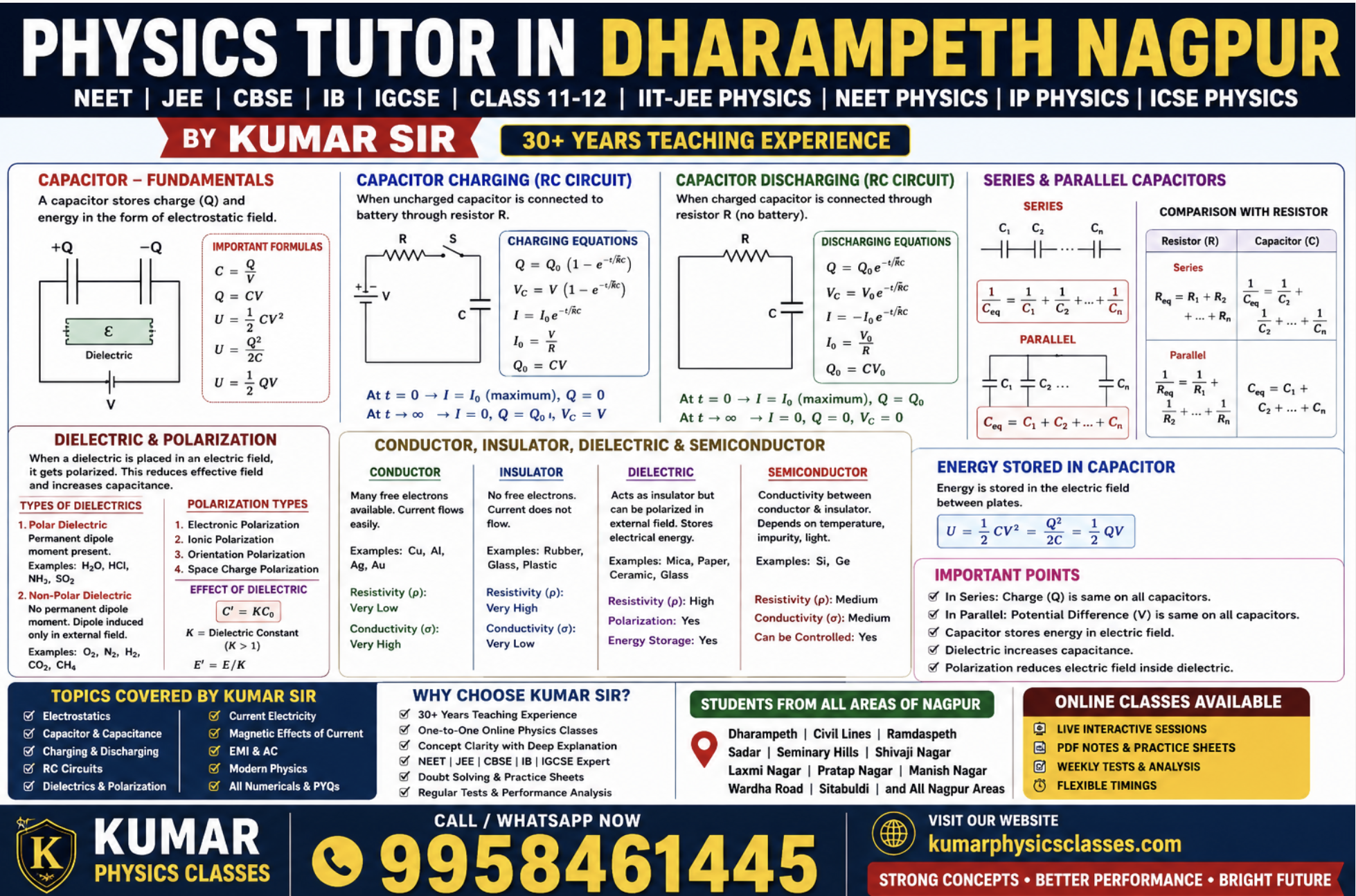
1/C equivalent = 1/C1 + 1/C2 + 1/C3 + … + 1/Cn
For resistors in parallel:
1/R equivalent = 1/R1 + 1/R2 + 1/R3 + … + 1/Rn
But for capacitors in parallel:
C equivalent = C1 + C2 + C3 + … + Cn
This is the most important point students must remember.
Capacitors in Series
When capacitors are connected in series, the charge on each capacitor remains the same.
Important point:
In series combination of capacitors, charge is same.
Formula:
1/C equivalent = 1/C1 + 1/C2 + 1/C3 + … + 1/Cn
If two capacitors are connected in series:
1/C equivalent = 1/C1 + 1/C2
For two capacitors, we can also write:
C equivalent = C1 C2 / (C1 + C2)
In series combination, potential difference divides across different capacitors. The capacitor with smaller capacitance gets larger potential difference.
So remember:
Series capacitors: Same charge, different potential difference.
Capacitors in Parallel
When capacitors are connected in parallel, potential difference across each capacitor remains the same.
Important point:
In parallel combination of capacitors, potential difference is same.
Formula:
C equivalent = C1 + C2 + C3 + … + Cn
If two capacitors are connected in parallel:
C equivalent = C1 + C2
In parallel combination, charge divides among different capacitors. The capacitor with larger capacitance stores more charge.
So remember:
Parallel capacitors: Same potential difference, different charge.
Energy Stored in a Capacitor
A capacitor stores energy in the form of electrostatic energy. When a capacitor is charged, electric field is produced between its plates, and energy is stored in that electric field.
Important formulas:
Energy stored = 1/2 C V²
Energy stored = Q² / 2C
Energy stored = 1/2 QV
Here:
C = capacitance
V = potential difference
Q = charge
Students should not only memorize these formulas. They should understand when to use which formula. Kumar Sir explains this with proper numerical examples, diagrams and step-by-step logic.
Why Students in Dharampeth Nagpur Need Kumar Sir
If you are living in Dharampeth Nagpur and preparing for NEET, JEE, CBSE, IB, IGCSE, ICSE, ISC, AP Physics or A-Level Physics, then Physics must be handled seriously from the beginning.
Many students face problems like:
Formula confusion
Weak basic concepts
Difficulty in numericals
Confusion between series and parallel
Mistakes in sign convention
Poor test performance
Backlog in Class 11 Physics
Lack of personal guidance
Fear of Physics
Kumar Sir teaches one-to-one, so every student gets personal attention. In big batches, students often hesitate to ask doubts. But in Kumar Sir’s class, the student can ask every small doubt freely.
Physics Tutor for Competitive Exams
Students searching for Physics Tutor of NEET Physics, Physics Tutor of IIT JEE Physics, Physics Tutor of JEE Main Physics, Physics Tutor of JEE Advanced Physics, Physics Tutor of AP Physics, Physics Tutor of IB Physics, Physics Tutor of IGCSE Physics, Physics Tutor of ICSE Physics, Physics Tutor of CBSE Physics, Physics Tutor of ISC Physics, Physics Tutor of A Level Physics can join Kumar Physics Classes for complete concept clarity.
For NEET students, Physics can become the rank-deciding subject. Biology and Chemistry may be strong, but if Physics is weak, selection becomes difficult. Kumar Sir helps NEET students improve Physics marks through concept clarity, NCERT-based understanding, PYQ practice and test analysis.
For JEE students, Physics needs deeper thinking. Kumar Sir explains concepts from basic to advanced level so that students can handle both JEE Main and JEE Advanced questions.
Physics Tutor Near Schools and Institutes in Nagpur
Students from top schools and institutions can also join Kumar Sir’s online classes. If you are searching for Physics Tutor in Centre Point School Nagpur, Physics Tutor in Delhi Public School Nagpur, Physics Tutor in Bhavan’s Bhagwandas Purohit Vidya Mandir Nagpur, Physics Tutor in Jain International School Nagpur, Physics Tutor in The Achievers School Nagpur, Physics Tutor in Podar International School Nagpur, Physics Tutor in Global Indian International School Nagpur, Physics Tutor in Hislop College Nagpur, Physics Tutor in Rashtrasant Tukadoji Maharaj Nagpur University, Kumar Sir can guide you personally.
How Kumar Sir Teaches Capacitors
Kumar Sir does not teach capacitors only by formulas. He explains the logic behind every formula.
For example:
When capacitors are in series, charge remains same because there is only one path for charge distribution.
When capacitors are in parallel, potential difference remains same because all capacitors are connected across the same two points.
This type of conceptual clarity helps students solve numerical problems quickly.
Important capacitor concepts taught by Kumar Sir:
Meaning of capacitance
Parallel plate capacitor
Series combination
Parallel combination
Charge distribution
Potential difference distribution
Energy stored in capacitor
Dielectric effect
Capacitor with battery
Capacitor without battery
Mixed capacitor circuits
NEET and JEE previous year questions
Copy-Paste Friendly Formula Section
Capacitor in series:
1/Ceq = 1/C1 + 1/C2 + 1/C3 + … + 1/Cn
Capacitor in parallel:
Ceq = C1 + C2 + C3 + … + Cn
Resistor in series:
Req = R1 + R2 + R3 + … + Rn
Resistor in parallel:
1/Req = 1/R1 + 1/R2 + 1/R3 + … + 1/Rn
Energy stored in capacitor:
U = 1/2 CV²
U = Q²/2C
U = 1/2 QV
Charge on capacitor:
Q = CV
For series capacitors:
Charge is same
For parallel capacitors:
Potential difference is same
Final Words
If you are in Dharampeth Nagpur and Physics is creating problems in your NEET, JEE, CBSE, IB, IGCSE or Class 11–12 preparation, then do not wait for backlog to increase. Physics becomes easy only when concepts are clear.
For serious Physics preparation, choose Kumar Sir.
Kumar Sir has 30 years of teaching experience and teaches Physics in a simple, logical and result-oriented way.
Call / WhatsApp: +91-9958461445
Website: Kumar Physics Classes
Capacitor Charging, Discharging and Dielectric – Kumar Sir Style Explanation
A capacitor is a device that stores electric charge and electrical energy in the form of an electrostatic field. In simple words, when we connect a capacitor with a battery, charge starts collecting on its plates. One plate becomes positive and the other plate becomes negative. This process is called charging of capacitor.
When a capacitor is charging, current is maximum in the beginning because the capacitor is empty. Slowly, as charge increases on the plates, potential difference across the capacitor also increases. After some time, the capacitor becomes fully charged and current becomes almost zero.
Copy-paste friendly formula:
Q = CV
Energy stored in capacitor = 1/2 CV²
When a charged capacitor is connected through a resistor without battery, it starts losing its stored charge. This process is called discharging of capacitor. During discharging, charge, voltage and current decrease with time. In the beginning, discharging current is maximum, and after some time it becomes almost zero.
A capacitor is made of two conducting plates separated by an insulating material. This insulating material is called dielectric. Dielectric does not allow direct flow of charge, but it increases the capacitance of the capacitor. Common dielectric materials are air, paper, mica, ceramic, glass, plastic film, oxide layer and electrolytic material.
The main work of dielectric is to increase charge storing capacity, reduce electric field effect inside the capacitor and improve energy storage. If dielectric constant is high, capacitance also increases.
In industrial applications, capacitors are used in power factor correction, fan motors, AC circuits, filters, tuning circuits, camera flash, energy storage systems, power supplies, inverters, electric vehicles, communication systems and electronic devices. In industries, large capacitors help reduce power loss and improve efficiency of electrical machines.
Physics Tutor Kumar Sir teaches capacitors in a very practical way. He does not only make students memorize formulas. He explains why charge is stored, how dielectric works, why current becomes zero after full charging, and how capacitor behaves in DC and AC circuits.
If you are preparing for NEET, JEE, CBSE, IB or IGCSE Physics, then capacitor is a very important topic. Learn it properly from Physics Tutor Kumar Sir and build strong concepts for numerical solving.
Dielectric, Polarization, Conductor, Insulator and Semiconductor
A dielectric is an insulating material that does not allow free flow of charge, but it can store electrical energy when placed in an electric field. In capacitors, dielectric is placed between two plates to increase capacitance and energy storage capacity. Students learning from Physics Tutor in Nagpur understand this concept with simple examples and diagrams.
Types of Dielectrics
Dielectrics are mainly of two types:
1. Polar Dielectric
In polar dielectrics, positive and negative charge centres do not coincide even without an external electric field. They already have permanent dipole moment. Examples are water, HCl and ammonia.
2. Non-Polar Dielectric
In non-polar dielectrics, positive and negative charge centres coincide in normal condition. They do not have permanent dipole moment. But when an external electric field is applied, charge centres slightly separate and induced dipoles are formed. Examples are oxygen, nitrogen, hydrogen and carbon dioxide.
Polarization
Polarization is the process in which dipoles inside a dielectric get aligned or induced due to an external electric field. When a dielectric is placed in an electric field, its molecules respond to the field. In polar dielectrics, permanent dipoles try to align with the field. In non-polar dielectrics, induced dipoles are created.
This reduces the effective electric field inside the dielectric and increases capacitance. Kumar Sir explains polarization by showing how positive and negative charge centres shift inside the material.
Conductor, Insulator, Dielectric and Semiconductor
A conductor is a material in which free electrons are available in large numbers. Due to these free electrons, current can flow easily. Examples are copper, aluminium and silver.
An insulator is a material in which free electrons are not available for conduction. It does not allow current to flow easily. Examples are rubber, glass, plastic and wood.
A dielectric is also an insulator, but it has a special property: it can be polarized in an electric field and can store electrical energy. So every dielectric is an insulator, but every insulator may not be a good dielectric.
A semiconductor is a material whose conductivity lies between conductor and insulator. Its conductivity can be controlled by temperature, doping or light. Examples are silicon and germanium.
Students preparing for NEET, JEE, CBSE, IB and IGCSE should learn these concepts deeply from Physics Tutor in Nagpur, because electrostatics and capacitors are very important for exams.
In simple words, conductor allows charge flow, insulator stops charge flow, dielectric stores electrical energy by polarization, and semiconductor controls current flow.