Physics Tutor in Erandwane Pune – Understanding Concave Lens Magnification with Kumar Sir
+91-9958461445
If you are searching for a Physics Tutor in Erandwane Pune for Class 11, Class 12, JEE, NEET, or board preparation, then learning Physics with proper concepts becomes extremely important. Many students feel confused while studying optics, especially topics like concave lens magnification, sign convention, positive and negative magnification, and image formation.
At Kumar Physics Classes, Kumar Sir explains these concepts in a very simple and practical way so that students can easily understand even difficult numerical problems.
What is Magnification in a Concave Lens?
In Physics, magnification tells us how large or small the image is compared to the object.
For a lens:
[
m = \frac{h_2}{h_1} = \frac{v}{u}
]
Where:
(h_1) = height of object
(h_2) = height of image
(u) = object distance
(v) = image distance
In a concave lens, magnification is generally positive because the image formed is virtual and erect.
Positive and Negative Magnification
Students often get confused about when magnification becomes positive or negative.
Positive Magnification
Image is virtual and erect
Image forms on the same side as the object
Usually happens in a concave lens
Height of image is taken positive
So for a concave lens:
[
m = +\frac{h_2}{h_1}
]
This means the image is upright.
Negative Magnification
Negative magnification means the image is inverted.
This usually happens in a convex lens when a real image is formed.
[
m = -\frac{h_2}{h_1}
]
Here the negative sign shows that the image is upside down.
Why is Concave Lens Focal Length Negative?
According to the Cartesian sign convention:
Distances measured opposite to the direction of incident light are negative.
A concave lens diverges light rays.
Its focus lies on the same side as the object.
Therefore, focal length of a concave lens is negative.
[
f < 0
]
This is one of the most important concepts in ray optics and is frequently asked in NEET and JEE examinations.
How Kumar Sir Explains Optics
Kumar Sir focuses strongly on concept clarity rather than rote learning.
Students are taught:
Sign convention tricks
Lens formula derivation
Real vs virtual image concepts
Numerical solving methods
Ray diagram shortcuts
Board exam answer writing
JEE and NEET level MCQs
Every chapter is taught step-by-step so that students develop confidence in Physics.
Physics Tutor in Erandwane Pune for JEE and NEET
Students from Erandwane and nearby Pune areas often search for experienced Physics guidance for competitive exams.
Kumar Sir has many years of teaching experience and has taught students preparing for:
IIT JEE
NEET
CBSE Class 11 Physics
CBSE Class 12 Physics
Maharashtra Board Physics
Olympiad Physics
Nearby Schools and Colleges in and around Erandwane Pune
Students from the following schools and colleges can benefit from online Physics tuition:
Physics Tutor in Abasaheb Garware College Pune
Physics Tutor in BMCC Pune
Physics Tutor in MES Garware College Pune
Physics Tutor in Deccan Education Society Pune
Physics Tutor in Fergusson College Pune
Physics Tutor in Modern College Pune
Physics Tutor in Symbiosis School Pune
Physics Tutor in SNDT College Pune
Physics Tutor in MIT Junior College Pune
Physics Tutor in JSPM College Pune
Physics Tutor in Sinhgad College Pune
Physics Tutor in Kothrud Pune
Physics Tutor in Deccan Pune
Physics Tutor in Karve Nagar Pune
Physics Tutor in Shivajinagar Pune
Physics Tutor in Aundh Pune
Physics Tutor in Baner Pune
Why Students Prefer Kumar Physics Classes?
One-to-one attention
Online interactive classes
Deep conceptual teaching
Numerical problem solving
Regular doubt sessions
Test series and assignments
NEET and JEE focused preparation
Experienced faculty guidance
Many students who were weak in Physics improved their confidence after learning from Kumar Sir.
Join Kumar Physics Classes
If you are looking for a reliable and experienced Physics Tutor in Erandwane Pune, you can connect with Kumar Sir for online Physics coaching.
Website: https://kumarphysicsclasses.com
For JEE, NEET, Class 11 and 12 Physics tuition, visit:
https://kumarphysicsclasses.com
Contact Kumar Physics Classes for concept-based Physics learning and strong exam preparation.
Magnification in Physics – Explained by Kumar Sir
Magnification is one of the most important concepts in optics. It tells us how large or small the image formed by a mirror or lens is compared to the actual object. In Physics, magnification is represented by:
m=\frac{h_2}{h_1}=\frac{v}{u}
Here, (h_1) is the height of the object, (h_2) is the height of the image, (u) is the object distance, and (v) is the image distance.
According to Kumar Sir, students usually make mistakes in magnification because they ignore sign convention. If the image is erect and virtual, magnification becomes positive. If the image is real and inverted, magnification becomes negative.
In a concave lens, magnification is generally positive because the image formed is virtual and upright. In a convex lens, when a real image is formed, magnification becomes negative because the image is inverted.
Magnification also tells us whether the image is enlarged or diminished. If (m > 1), the image is enlarged. If (m < 1), the image is smaller than the object.
Kumar Sir explains magnification through ray diagrams, practical examples, and numerical questions so that students preparing for NEET and JEE can easily understand optics concepts deeply and confidently.
Why Different Colours Have Different Refractive Indices? – Dispersion of Light Explained by Kumar Sir
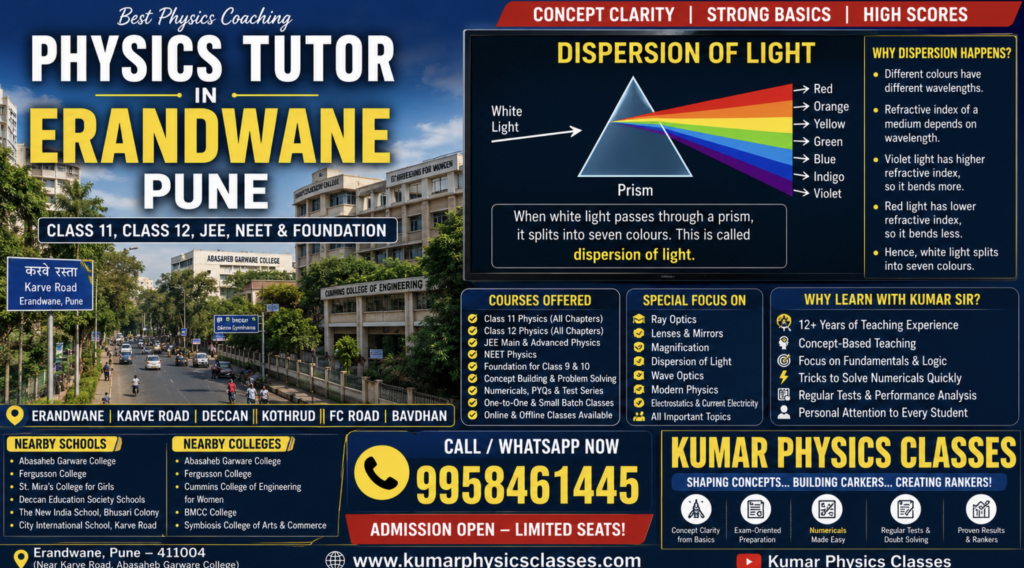
Many students ask an important question in optics: why does white light split into different colours when it passes through a prism? Why do different colours bend by different amounts? The answer lies in the concept of refractive index and dispersion of light.
The refractive index of a medium is defined as:
n=\frac{c}{v}
Here, (c) is the speed of light in vacuum and (v) is the speed of light in the medium.
According to Kumar Sir, different colours of light have different wavelengths. Violet light has the shortest wavelength while red light has the longest wavelength in visible light.
When light enters a medium like glass, the speed of different colours changes differently. Since refractive index depends on speed, every colour experiences a different refractive index inside the prism.
Violet light slows down more inside glass. Therefore, its refractive index is higher. Red light slows down less, so its refractive index is lower.
This is why:
Violet colour bends the most
Red colour bends the least
This phenomenon is called dispersion of light.
When white light enters a prism, each colour refracts through a different angle because each colour has a different refractive index. As a result, white light splits into seven colours known as VIBGYOR:
Violet
Indigo
Blue
Green
Yellow
Orange
Red
Students often think the prism creates colours, but actually all colours are already present inside white light. The prism only separates them because different colours travel with different speeds inside glass.
Kumar Sir explains this concept using wave theory and practical imagination. Imagine students running on a road and then entering mud. Some slow down more while others slow down less. Similarly, different colours slow down differently inside glass.
The angle of deviation depends upon refractive index. Since violet has maximum refractive index, it deviates the most. Red has minimum refractive index, so it deviates the least.
This concept is extremely important for:
Ray optics
Prism numericals
Dispersion questions
Rainbow formation
Optical instruments
NEET Physics
JEE Main and Advanced
According to Kumar Sir, students should always remember one golden rule:
“Higher refractive index means lower speed of light inside the medium.”
That single idea explains refraction, dispersion, prism behaviour, and even rainbow formation very beautifully.