
Physics Tutor in Deccan Gymkhana Pune – Power of Lens, Lens Maker Formula and Conceptual Physics Explained by Kumar
+91-9958461445
Physics becomes easy and interesting when students understand the physical meaning behind formulas instead of memorizing equations blindly. One of the most important topics in Ray Optics is power of lens, focal length, refractive index, and lens maker formula. Students preparing for NEET Physics, IIT-JEE Physics, AP Physics, IB Physics, A Level Physics, IGCSE Physics, CBSE Physics, ICSE Physics, and engineering entrance examinations often get confused while solving numerical problems related to lenses because they do not understand the conceptual meaning of focal length and refractive index properly.
At Kumar Physics Classes Deccan Gymkhana Pune, students are taught concepts deeply using H.C. Verma, Resnick Halliday, and I.E. Irodov-based conceptual methods. Kumar Sir focuses on logic, visualization, derivation, and problem-solving techniques.
If you are living in Deccan Gymkhana Pune or nearby areas and searching for a Physics Tutor for NEET Physics, IIT-JEE Physics, AP Physics, IB Physics, A Level Physics, IGCSE Physics, British Curriculum Physics, CBSE Physics, ICSE Physics, or college-level Physics, then Kumar Physics Classes can help you build strong conceptual understanding and numerical-solving confidence.
What is Power of a Lens?
Power of a lens tells how strongly the lens converges or diverges light rays.
Mathematically:
P = 1/f
Where:
P = power of lens
f = focal length in meter
This is the most important point students forget.
Many students make a common mistake:
They take focal length in centimeters.
But focal length must always be taken in meters while calculating power.
SI Unit of Power
SI unit of power of lens is:
Dioptre
If focal length is:
1 meter
then power becomes:
1 Dioptre
Convex lens has:
positive power
Concave lens has:
negative power
Combination of Lenses
Suppose many thin lenses are placed together.
Then equivalent focal length is given by:
1/F = 1/F1 + 1/F2 + 1/F3 + …
Similarly, powers add directly:
P = P1 + P2 + P3 + …
This makes numerical calculations easier.
At Kumar Physics Classes Deccan Gymkhana Pune, students are taught shortcut methods and conceptual derivations together.
Lens Maker Formula
Lens maker formula is one of the most important formulas in optics.
It gives relation between:
focal length
refractive index
radii of curvature
General formula:
1/f = (mu − 1)(1/R1 − 1/R2)
Where:
mu = refractive index of lens material with respect to surrounding medium
R1 and R2 = radii of curvature
Lens in Different Medium
Students often get confused when lens is immersed in water.
Suppose:
lens material = glass
surrounding medium = water
Then relative refractive index becomes:
mu_g / mu_w
So lens maker formula becomes:
1/f = (mu_g/mu_w − 1)(1/R1 − 1/R2)
This is extremely important for NEET Physics and IIT-JEE Physics.
What Happens When Lens is Put in Water?
When convex lens is immersed in water:
refractive index difference decreases
converging power decreases
focal length increases
This is because water already bends light partially.
Hence lens becomes weaker inside water.
Importance of Refractive Index
Refractive index tells:
how much light bends
optical density of medium
speed of light in medium
Formula:
mu = c/v
Where:
c = speed of light in vacuum
v = speed of light in medium
Higher refractive index means:
lower speed of light
greater bending
Why Students Fear Optics
Students generally fear Ray Optics because of:
sign convention
multiple formulas
lens combinations
refractive index concepts
image formation
magnification
But once concepts become clear, optics becomes one of the easiest and highest-scoring chapters.
At Kumar Physics Classes Deccan Gymkhana Pune, concepts are taught using:
ray diagrams
derivations
visual explanation
numerical applications
conceptual learning
How Kumar Sir Teaches Physics
Kumar Sir mainly follows:
H.C. Verma
Resnick Halliday
I.E. Irodov
because these books develop:
conceptual clarity
logical thinking
advanced numerical-solving ability
Students preparing for NEET Physics and IIT-JEE Physics especially benefit from conceptual teaching methods.
NEET Physics – Is 180 Marks Difficult?
Many students think scoring high marks in Physics is impossible.
But the reality is:
Scoring 160–180 marks in NEET Physics is absolutely possible if:
NCERT Physics is revised properly
concepts are clear
formulas are understood physically
H.C. Verma is practiced multiple times
module questions are solved conceptually
Most students fail not because Physics is difficult, but because concepts remain weak.
Aakash and Allen Students
Many students studying in:
Aakash Institute
Allen Institute
PW
FIITJEE
Resonance
often struggle in module questions because classroom teaching moves very fast.
Sometimes institutes cannot provide individual conceptual attention to every student.
In such situations, students can:
study modules from coaching
clear conceptual doubts from Kumar Sir
strengthen weak chapters
improve numerical-solving techniques
This approach helps students perform better in NEET Physics and IIT-JEE Physics.
Why Conceptual Physics Matters
Competitive exams now ask:
conceptual questions
assertion-reason questions
graph-based questions
mixed-concept numericals
Therefore memorization alone cannot help.
Students must understand:
why formula works
physical meaning
derivation logic
application in numericals
This is the teaching philosophy at Kumar Physics Classes.
Applications of Convex Lens
Convex lenses are used in:
microscopes
telescopes
cameras
spectacles
projectors
mobile cameras
medical instruments
Understanding focal length and power is important in all these devices.
Physics Tutor in Deccan Gymkhana Pune – Areas Covered
Physics Tutor in Deccan Gymkhana Pune, Physics Tutor in Shivajinagar Pune, Physics Tutor in FC Road Pune, Physics Tutor in JM Road Pune, Physics Tutor in Prabhat Road Pune, Physics Tutor in Model Colony Pune, Physics Tutor in Kothrud Pune, Physics Tutor in Aundh Pune, Physics Tutor in Baner Pune, Physics Tutor in Erandwane Pune
Physics Tutor Near Colleges and Universities
Physics Tutor in Fergusson College Pune, Physics Tutor in COEP Pune, Physics Tutor in MIT World Peace University Pune, Physics Tutor in Symbiosis Pune, Physics Tutor in BMCC Pune, Physics Tutor in Modern College Pune
Physics Tutor Near Schools
Physics Tutor in Delhi Public School Pune, Physics Tutor in Vibgyor High School Pune, Physics Tutor in DAV School Pune, Physics Tutor in Orchid School Pune
Physics Tutor for Different Curriculums
Physics Tutor for NEET Physics Pune, Physics Tutor for IIT-JEE Physics Pune, Physics Tutor for AP Physics Pune, Physics Tutor for IB Physics Pune, Physics Tutor for A Level Physics Pune, Physics Tutor for IGCSE Physics Pune, Physics Tutor for British Curriculum Physics Pune, Physics Tutor for CBSE Physics Pune, Physics Tutor for ICSE Physics Pune
Contact Kumar Physics Classes
Website: kumarphysicsclasses.com
Phone: +91-9958461445
Email: KUMARSIRPHYSICS@GMAIL.COM
Courses Available:
NEET Physics
IIT-JEE Physics
AP Physics
IB Physics
A Level Physics
IGCSE Physics
CBSE Physics
ICSE Physics
College Physics
Why Students Prefer Kumar Physics Classes
Students prefer Kumar Physics Classes because:
concepts are explained deeply
doubts are solved personally
derivations are taught logically
numericals are solved step-by-step
advanced concepts become easy
conceptual confidence increases
Students from many coaching institutes take conceptual support from Kumar Sir to strengthen Physics fundamentals.
Conclusion
Power of lens, refractive index, focal length, and lens maker formula are among the most important topics in Ray Optics.
Students who understand:
focal length
refractive index
optical density
lens combinations
converging and diverging behavior
power of lens
develop strong conceptual foundations.
At Kumar Physics Classes Deccan Gymkhana Pune, Physics is taught conceptually, visually, mathematically, and logically so students can confidently solve NEET Physics, IIT-JEE Physics, AP Physics, IB Physics, A Level Physics, IGCSE Physics, and Olympiad-level questions.
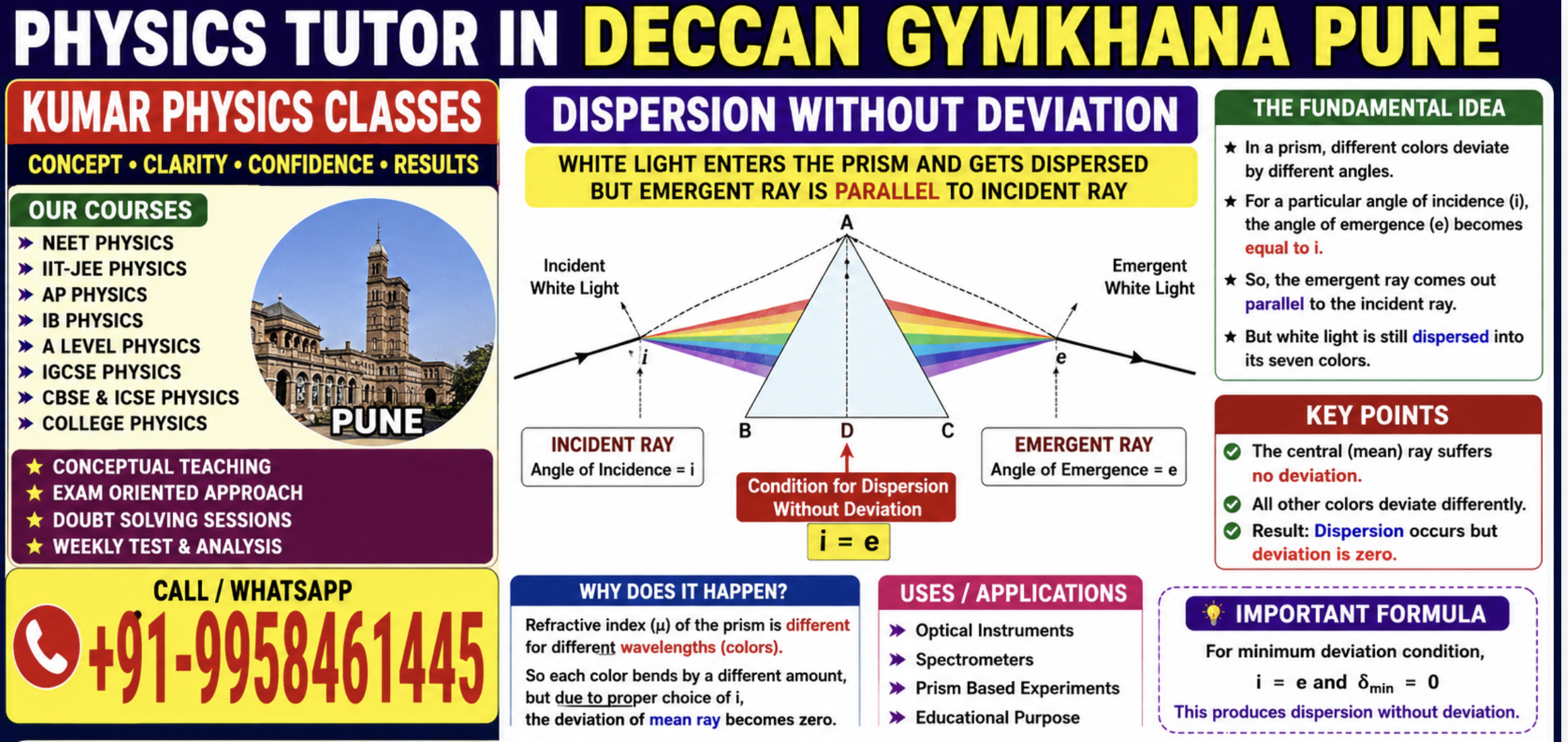
Dispersion of Light
Dispersion is the phenomenon in which white light splits into its constituent seven colors when it passes through a prism.
Dispersion Without Deviation
Dispersion without deviation is the phenomenon in which white light gets dispersed into colors but the emergent central ray remains parallel to the incident ray.
Causes of Dispersion
Dispersion occurs because refractive index of a medium is different for different wavelengths (colors) of light.
Rainbow
Rainbow is a natural spectrum formed in the sky due to dispersion, refraction, and total internal reflection of sunlight inside water droplets.
Formation of Primary Rainbow
Primary rainbow is formed when sunlight undergoes:
one refraction,
one total internal reflection,
and another refraction inside water droplets.
In primary rainbow:
red color appears outside,
violet appears inside.
Angle is approximately:
42 degrees.
Formation of Secondary Rainbow
Secondary rainbow is formed when sunlight undergoes:
two total internal reflections inside water droplets.
In secondary rainbow:
violet color appears outside,
red appears inside.
Angle is approximately:
51 degrees.
Secondary rainbow is fainter than primary rainbow.
Scattering of Light
Scattering of light is the phenomenon in which light deviates from its straight path when it strikes small particles or molecules.
Example:
blue color of sky
reddish color of sunset
Magnification of Simple Microscope
Magnification of simple microscope is defined as the ratio of angle subtended by final image at eye to the angle subtended by object at eye without microscope.
Formula:
M = 1 + D/f
Where:
D = least distance of distinct vision
f = focal length
Magnification of Compound Microscope
Magnification of compound microscope is the product of magnification produced by objective lens and eyepiece.
Formula:
M = (L/f₀)(D/fₑ)
Where:
L = tube length
f₀ = focal length of objective
fₑ = focal length of eyepiece
Magnification of Astronomical Telescope
Magnification of astronomical telescope is defined as the ratio of angle subtended by final image at eye to angle subtended by distant object at unaided eye.
Formula:
M = f₀/fₑ
Where:
f₀ = focal length of objective
fₑ = focal length of eyepiece
Magnification of Reflecting Type Telescope
Magnification of reflecting telescope is also given by:
M = f₀/fₑ
Here objective is a concave mirror instead of a lens.
Reflecting telescopes are used in observatories because mirrors do not produce chromatic aberration.