
Physics Tutor in Prabhat Road Pune – Lens Maker Formula, Refraction and Convex Lens Explained by Kumar
+91-9958461445
Physics becomes truly interesting when students understand the physical meaning behind formulas instead of memorizing equations blindly. One of the most important chapters in Ray Optics is the chapter of lenses, refractive index, focal length, image formation, and lens maker formula. Students preparing for NEET Physics, IIT-JEE Physics, AP Physics, IB Physics, A Level Physics, IGCSE Physics, CBSE Physics, ICSE Physics, and engineering entrance examinations often get confused in concepts related to convex lenses, concave lenses, refractive index, power of lens, and focal length variation in different media.
At Kumar Physics Classes Prabhat Road Pune, students are taught concepts visually and logically using deep conceptual explanations inspired by H.C. Verma, Resnick Halliday, and I.E. Irodov. Kumar Sir focuses on understanding instead of rote memorization.
If you are living in Prabhat Road Pune or nearby localities and searching for a Physics Tutor for NEET Physics, IIT-JEE Physics, AP Physics, IB Physics, A Level Physics, IGCSE Physics, British Curriculum Physics, CBSE Physics, or ICSE Physics, then Kumar Physics Classes can help you develop strong fundamentals and advanced numerical-solving skills.
What is a Convex Lens?
A convex lens is a converging lens which bends parallel rays towards a point called the principal focus.
Convex lenses are thicker at the center and thinner at the edges.
These lenses are widely used in:
cameras
microscopes
telescopes
spectacles
optical instruments
The most important property of a convex lens is that it converges light rays.
Plano Convex Lens
A plano convex lens has:
one flat surface
one convex surface
Students often ask an important conceptual question:
If two plano convex lenses are combined in different orientations, will focal length change?
The answer is conceptually very important.
Whether the curved surfaces face each other or the flat surfaces face each other, the net focal length remains the same if the geometry and refractive index remain unchanged.
This is because focal length depends upon:
refractive index
curvature
surrounding medium
and not merely orientation.
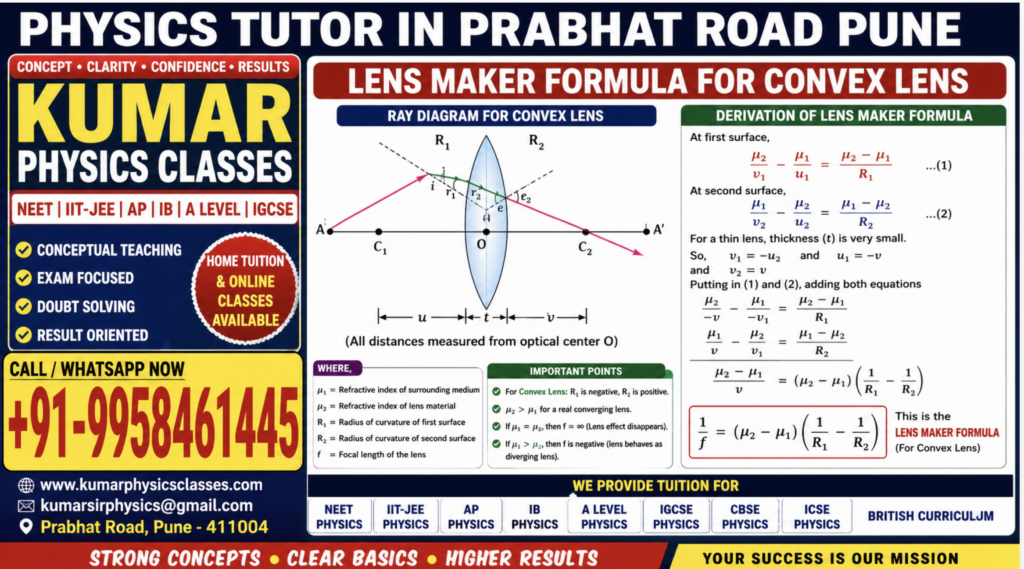
Lens Maker Formula
One of the most important formulas in optics is the lens maker formula.
For a thin lens:
1/f = (mu2/mu1 − 1)(1/R1 − 1/R2)
Where:
f = focal length
mu2 = refractive index of lens
mu1 = refractive index of surrounding medium
R1 and R2 = radii of curvature
This formula explains how focal length changes when the surrounding medium changes.
At Kumar Physics Classes Prabhat Road Pune, students are taught the physical meaning of this equation instead of memorizing it.
Case 1 – When mu1 = mu2
This is one of the most important conceptual cases.
Suppose:
refractive index of surrounding medium = refractive index of lens
Then:
(mu2/mu1 − 1) = 0
Therefore:
1/f = 0
Hence:
f = infinity
This means the lens loses its converging or diverging property.
The lens practically disappears optically.
Example:
If a glass lens is immersed in molten glass having same refractive index, the lens effect disappears.
This is an extremely important concept for IIT-JEE and Olympiad Physics.
Case 2 – When mu2 > mu1
This is the normal situation.
Example:
outside medium = air
lens material = glass
Since glass has higher refractive index than air:
mu2 > mu1
Therefore focal length becomes positive.
The lens behaves as:
Converging Lens
This is the standard behavior of a convex lens.
Parallel rays converge towards principal focus.
Case 3 – When mu1 > mu2
Now suppose surrounding medium has greater refractive index than lens.
Then:
(mu2/mu1 − 1)
becomes negative.
Hence focal length becomes negative.
Now the convex lens starts behaving like:
Diverging Lens
This is one of the most beautiful conceptual results in optics.
A convex lens can behave like a concave lens depending upon surrounding medium.
Students often memorize lens formulas but fail to understand this physical interpretation.
At Kumar Physics Classes, such concepts are taught deeply and visually.
What Happens When Lens is Immersed in Water?
Students are often asked:
“What happens to focal length when a convex lens is immersed in water?”
Water has refractive index greater than air.
Therefore relative refractive index decreases.
As a result:
1/f decreases
Hence focal length increases.
This means:
Power of lens decreases in water.
This is a highly important conceptual question for NEET Physics and IIT-JEE Physics.
Power of Lens
Power of lens is defined as:
P = 1/f
SI unit:
Dioptre
Convex lens has:
positive power
Concave lens has:
negative power
When focal length increases:
Power decreases.
When focal length decreases:
Power increases.
Why Students Find Ray Optics Difficult
Students usually struggle in optics because of:
sign conventions
multiple formulas
refraction concepts
lens combinations
refractive index
image formation
magnification
But when Physics is visualized properly, optics becomes one of the easiest chapters.
At Kumar Physics Classes Prabhat Road Pune, each concept is explained using:
ray diagrams
conceptual derivations
practical visualization
numerical applications
board-level approach
competitive exam approach
Importance of Refractive Index
Refractive index determines:
bending of light
speed of light in medium
optical density
focal length
image formation
Higher refractive index means:
more bending of light
lower speed of light
Applications of Convex Lens
Convex lenses are used in:
spectacles
projectors
cameras
microscopes
telescopes
mobile phone cameras
medical instruments
magnifying glasses
Understanding focal length variation is important in all optical instruments.
Why Conceptual Physics is Important
Students preparing for:
NEET Physics
IIT-JEE Physics
Olympiads
AP Physics
IB Physics
A Level Physics
must understand concepts deeply instead of memorizing shortcuts.
Conceptual understanding helps students solve:
advanced numericals
assertion-reason questions
passage-based questions
multiple-concept problems
Why Students Choose Kumar Physics Classes
Students prefer Kumar Physics Classes because:
concepts are explained visually
formulas are derived logically
deep numerical training is provided
one-to-one conceptual guidance is available
international curriculum support is available
doubts are solved fundamentally
Kumar Sir mainly follows:
H.C. Verma
Resnick Halliday
I.E. Irodov
for conceptual and advanced Physics teaching.
Physics Tutor in Prabhat Road Pune – Areas Covered
Physics Tutor in Prabhat Road Pune, Physics Tutor in Model Colony Pune, Physics Tutor in Shivajinagar Pune, Physics Tutor in Deccan Pune, Physics Tutor in FC Road Pune, Physics Tutor in JM Road Pune, Physics Tutor in Erandwane Pune, Physics Tutor in Kothrud Pune, Physics Tutor in Baner Pune, Physics Tutor in Aundh Pune
Physics Tutor Near Schools and Universities
Physics Tutor in Fergusson College Pune, Physics Tutor in COEP Pune, Physics Tutor in MIT World Peace University Pune, Physics Tutor in Symbiosis Pune, Physics Tutor in BMCC Pune, Physics Tutor in Modern College Pune, Physics Tutor in Vibgyor High School Pune, Physics Tutor in Delhi Public School Pune
Physics Tutor for Different Curriculums
Physics Tutor for NEET Physics Pune, Physics Tutor for IIT-JEE Physics Pune, Physics Tutor for AP Physics Pune, Physics Tutor for IB Physics Pune, Physics Tutor for A Level Physics Pune, Physics Tutor for IGCSE Physics Pune, Physics Tutor for British Curriculum Physics Pune, Physics Tutor for CBSE Physics Pune, Physics Tutor for ICSE Physics Pune
Contact Kumar Physics Classes
Website: kumarphysicsclasses.com
Phone: +91-9958461445
Email: KUMARSIRPHYSICS@GMAIL.COM
Courses Available:
NEET Physics
IIT-JEE Physics
AP Physics
IB Physics
A Level Physics
IGCSE Physics
CBSE Physics
ICSE Physics
College Physics
Conclusion
Lens maker formula and refractive index are among the most important concepts in Ray Optics.
Students who understand:
focal length variation
refractive index
convex lens behavior
optical density
power of lens
converging and diverging behavior
develop very strong conceptual understanding.
At Kumar Physics Classes Prabhat Road Pune, Physics is taught conceptually, visually, and mathematically so students can confidently solve NEET Physics, IIT-JEE Physics, AP Physics, IB Physics, A Level Physics, IGCSE Physics, and Olympiad-level questions.
Refractive index is a physical quantity which tells how much light bends when it travels from one medium to another medium. It is defined as the ratio of speed of light in vacuum to the speed of light in the medium.
mu = c / v
Higher refractive index means light travels slower in that medium and bends more.
Focal length is the distance between the optical center of the lens and its principal focus. It tells the converging or diverging power of a lens. Convex lens has positive focal length while concave lens has negative focal length.
There is an important relation between refractive index and wavelength. When light enters a denser medium, frequency remains constant but wavelength decreases. Relation is:
mu = lambda_air / lambda_medium
This means higher refractive index corresponds to smaller wavelength inside the medium.
Cauchy’s formula explains variation of refractive index with wavelength. According to Cauchy’s formula:
mu = A + (B / lambda²)
where A and B are constants for the material. This formula shows that refractive index increases when wavelength decreases.
Lens maker formula gives relation between focal length, refractive index, and radii of curvature of a lens.
1/f = (mu – 1)(1/R1 – 1/R2)
This formula is used to calculate focal length of lenses.
When violet light is replaced by red light in a convex lens, focal length increases. This happens because refractive index for violet light is greater than refractive index for red light. Since refractive index decreases for red color, converging power decreases and focal length becomes larger.
Principal axis is the straight line passing through the optical center and centers of curvature of the lens. It is the reference line for image formation and ray diagrams.
These concepts are extremely important in Ray Optics for NEET Physics, IIT-JEE Physics, AP Physics, IB Physics, CBSE, ICSE, and A-Level Physics examinations.