
Physics Tutor in Aundh Pune – Oscillatory Motion, Vibratory Motion and Simple Harmonic Motion Explained by Kumar
+91-9958461445
Physics becomes easy when students understand the real meaning of motion instead of memorizing formulas blindly. One of the most beautiful chapters in Physics is Oscillatory Motion and Simple Harmonic Motion (SHM). Many students preparing for NEET Physics, IIT-JEE Physics, AP Physics, IB Physics, A Level Physics, CBSE Physics, ICSE Physics, IGCSE Physics, and British Curriculum Physics feel confused because they try to memorize equations without understanding the physical meaning behind them.
At Kumar Physics Classes Aundh Pune, oscillatory motion and SHM are explained in simple language with real-life examples, conceptual understanding, graphical visualization, and mathematical logic so that students can develop deep conceptual clarity.
What is Oscillatory Motion?
Oscillatory motion is the motion in which a body moves to and fro or back and forth about a fixed point.
This fixed point is generally called the mean position or equilibrium position.
Examples of oscillatory motion:
Simple pendulum
Spring mass system
Vibrating tuning fork
Guitar strings
Oscillation of molecules
Oscillation of a floating block in water
Balloon oscillation
Vibrating membranes
In oscillatory motion, the body repeatedly moves around the mean position.
What is Vibratory Motion?
Vibratory motion is also a type of oscillatory motion in which particles move to and fro about a fixed point.
Generally:
Large-scale oscillations are called oscillatory motion.
Small-scale rapid oscillations are called vibratory motion.
But in many Physics books both terms are used almost interchangeably.
Periodic Motion and Oscillatory Motion
One very important concept students must understand is:
All oscillatory motions are periodic motions, but all periodic motions are not oscillatory.
This line is extremely important for NEET and JEE.
What is Periodic Motion?
Periodic motion is the motion which repeats itself identically after a fixed interval of time.
That fixed interval of time is called Time Period.
Examples:
Earth revolving around the Sun
Rotation of Earth
Rotation of fan
Hands of a clock
These motions repeat after fixed intervals of time.
Why All Periodic Motions are Not Oscillatory
Students often become confused here.
For example:
Earth revolves around the Sun periodically.
But this motion is not oscillatory.
Why?
Because Earth is not moving to and fro about a fixed mean position.
Therefore:
It is periodic
But not oscillatory
This distinction is extremely important.
Time Period of Motion
The fixed interval of time after which motion repeats itself identically is called Time Period.
Generally represented by:
T
Examples:
Pendulum completing one oscillation
Spring returning to original position
Earth completing one revolution
What is Simple Harmonic Motion (SHM)?
Simple Harmonic Motion is a special type of oscillatory motion.
In SHM:
Restoring force is directly proportional to displacement
Restoring force acts toward mean position
Mathematically:
F = -ky
Negative sign shows restoring nature.
The force always acts opposite to displacement.
SHM Can Be Represented by Sine or Cosine Function
Many students think SHM must always be written as:
y = A sin(omega t)
But this is not compulsory.
SHM can also be written as:
y = A cos(omega t)
Both are correct.
Difference is only initial phase.
This is a very important conceptual understanding.
Why Sine and Cosine Both Represent SHM
Sine and cosine are periodic functions.
Periodic functions repeat after fixed intervals.
We know:
sin(theta + 2pi) = sin(theta)
cos(theta + 2pi) = cos(theta)
Therefore these functions naturally represent periodic motion.
That is why SHM is represented using trigonometric functions.
Velocity in SHM
Suppose displacement equation is:
y = A cos(omega t)
Differentiate with respect to time.
Then velocity becomes:
v = -A omega sin(omega t)
Now differentiate again.
Acceleration becomes:
a = -omega square A cos(omega t)
Therefore:
a = -omega square y
This is the standard equation of SHM.
Most Important Condition for SHM
Any motion becomes SHM if acceleration is proportional to displacement and opposite in direction.
Mathematically:
a = -omega square y
This is the heart of SHM.
Restoring Force in SHM
The first step in solving any SHM problem is finding restoring force.
Restoring force is always directed toward equilibrium position.
Therefore restoring force is always negative.
Students must remember this carefully.
Steps to Solve Any SHM Problem
At Kumar Physics Classes Aundh Pune, students are taught a systematic method.
Step 1 – Find Restoring Force
Restoring force must act toward mean position.
Step 2 – Apply Newton’s Second Law
F = ma
Step 3 – Substitute SHM Acceleration
a = -omega square y
Step 4 – Compare Equations
From comparison obtain omega.
Step 5 – Use Formula
omega = 2pi/T
Then calculate Time Period.
This method works for:
Springs
Pendulum
Floating blocks
Electric oscillations
Molecules
Fluid oscillations
and many advanced systems.
Why Restoring Force is Negative
Students often ask:
Why negative sign?
Negative sign shows direction.
If displacement is positive, restoring force acts negative.
If displacement is negative, restoring force acts positive.
Force always tries to bring body back to equilibrium position.
That is why restoring force is opposite to displacement.
Periodic Functions in SHM
If a function is periodic:
f(t) = f(t + T)
Also:
f(t) = f(t + 2T)
This means motion repeats identically after every time period.
This property is extremely important in wave motion and oscillation.
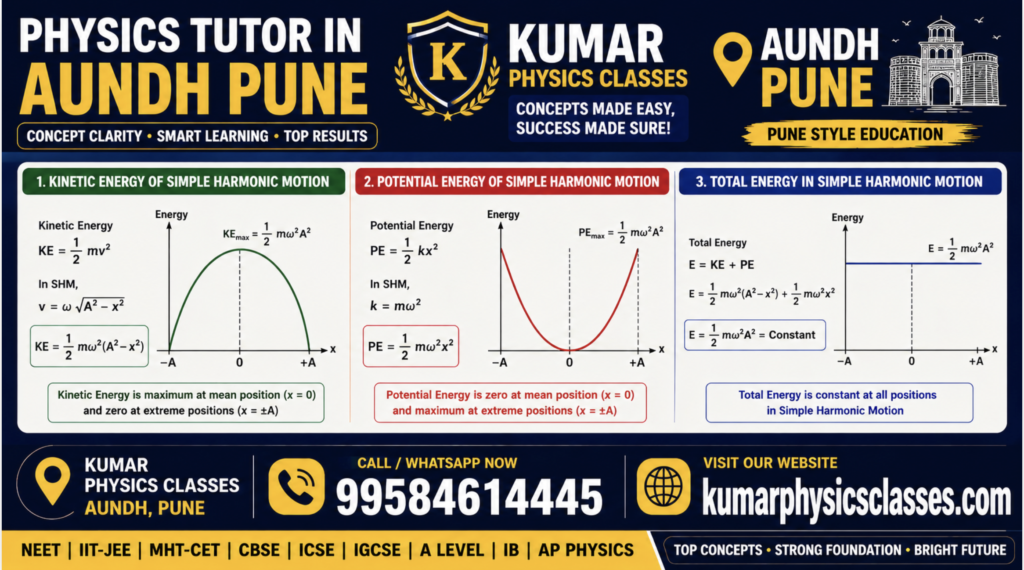
Total Energy in SHM
One of the most beautiful results in SHM is:
Total energy remains constant.
Energy continuously changes between:
Kinetic Energy
Potential Energy
But total energy remains conserved.
Mean Position and Extreme Position
At Mean Position:
Velocity maximum
Acceleration zero
Kinetic energy maximum
Potential energy minimum
At Extreme Position:
Velocity zero
Acceleration maximum
Potential energy maximum
Kinetic energy minimum
These concepts are extremely important for NEET and JEE.
SHM in Real Life
SHM exists everywhere in nature.
Examples include:
Vibrations of atoms
Vibrations of bridges
Oscillation of buildings
Earthquake waves
Oscillating electrical circuits
Vibrating mobile phones
Pendulum clocks
Vehicle suspension systems
Physics becomes interesting when students connect theory with real life.
Oscillation of a Floating Block in Water
Suppose a block is floating in water.
If pushed downward slightly:
Buoyant force increases
Upward restoring force acts
Block starts oscillating
This motion becomes SHM for small displacements.
Oscillation of Balloon
Suppose a balloon is suspended.
Small displacement creates restoring force due to tension.
For small oscillations motion becomes approximately SHM.
Spring Mass Oscillation
This is the most common SHM system.
Restoring force:
F = -kx
Using Newton’s Law:
ma = -kx
Therefore:
a = -(k/m)x
Comparing with:
a = -omega square x
We get:
omega = square root(k/m)
Time period:
T = 2pi square root(m/k)
This formula is extremely important.
Simple Pendulum
For small angular oscillations:
Time period:
T = 2pi square root(l/g)
Where:
l = length
g = acceleration due to gravity
Students must remember:
Time period does not depend upon mass.
Why SHM is Important for Competitive Exams
Oscillation is one of the highest weightage topics in:
NEET Physics
IIT-JEE Main
IIT-JEE Advanced
AP Physics
IB Physics
A Level Physics
IGCSE Physics
SAT Physics
Olympiads
Questions are asked from:
Phase difference
Time period
Energy
Graphs
Springs
Pendulum
Combination oscillation
SHM equations
Common Mistakes Students Make
Mistake 1 – Forgetting Negative Sign
Restoring force is always negative.
Mistake 2 – Confusing Periodic and Oscillatory Motion
Every oscillatory motion is periodic.
But every periodic motion is not oscillatory.
Mistake 3 – Memorizing Without Understanding
Students memorize formulas but fail in conceptual questions.
Mistake 4 – Ignoring Physical Meaning
Physics should always be visualized physically.
How Kumar Physics Classes Helps Students
At Kumar Physics Classes Aundh Pune:
Concepts are taught visually
Real-life examples are used
Difficult mathematics is simplified
Theory is explained deeply
NEET and JEE level questions are practiced
Students learn conceptual Physics
The focus is not only marks but real understanding.
Physics Tutor in Aundh Pune – Areas Covered
Physics Tutor in Aundh Pune, Physics Tutor in Baner Pune, Physics Tutor in Balewadi Pune, Physics Tutor in Wakad Pune, Physics Tutor in Pashan Pune, Physics Tutor in Bavdhan Pune, Physics Tutor in Hinjewadi Pune, Physics Tutor in Kothrud Pune, Physics Tutor in Shivajinagar Pune, Physics Tutor in Sus Pune, Physics Tutor in Pimpri Pune, Physics Tutor in Chinchwad Pune
Physics Tutor Near Schools in Pune
Physics Tutor in Orchid School Pune, Physics Tutor in Vibgyor High School Pune, Physics Tutor in DAV Public School Pune, Physics Tutor in Akshara International School Pune, Physics Tutor in MITCON School Pune, Physics Tutor in Symbiosis International School Pune, Physics Tutor in Delhi Public School Pune, Physics Tutor in Ryan International School Pune, Physics Tutor in Vidya Valley School Pune
Physics Tutor for Different Curriculums
Physics Tutor in NEET Physics Pune, Physics Tutor in IIT-JEE Physics Pune, Physics Tutor in AP Physics Pune, Physics Tutor in IB Physics Pune, Physics Tutor in A Level Physics Pune, Physics Tutor in IGCSE Physics Pune, Physics Tutor in British Curriculum Physics Pune, Physics Tutor in CBSE Physics Pune, Physics Tutor in ICSE Physics Pune
Conclusion
Oscillatory motion and Simple Harmonic Motion are among the most fundamental and beautiful topics in Physics.
Students who understand:
restoring force
periodic motion
oscillatory motion
SHM equations
sine and cosine functions
acceleration relation
energy conservation
time period
develop a very strong Physics foundation.
At Kumar Physics Classes Aundh Pune, students are taught Physics conceptually, visually, logically, and in a simple user-friendly way so that even difficult topics become easy for NEET, IIT-JEE, AP Physics, IB Physics, A Level Physics, and all major international curriculums.